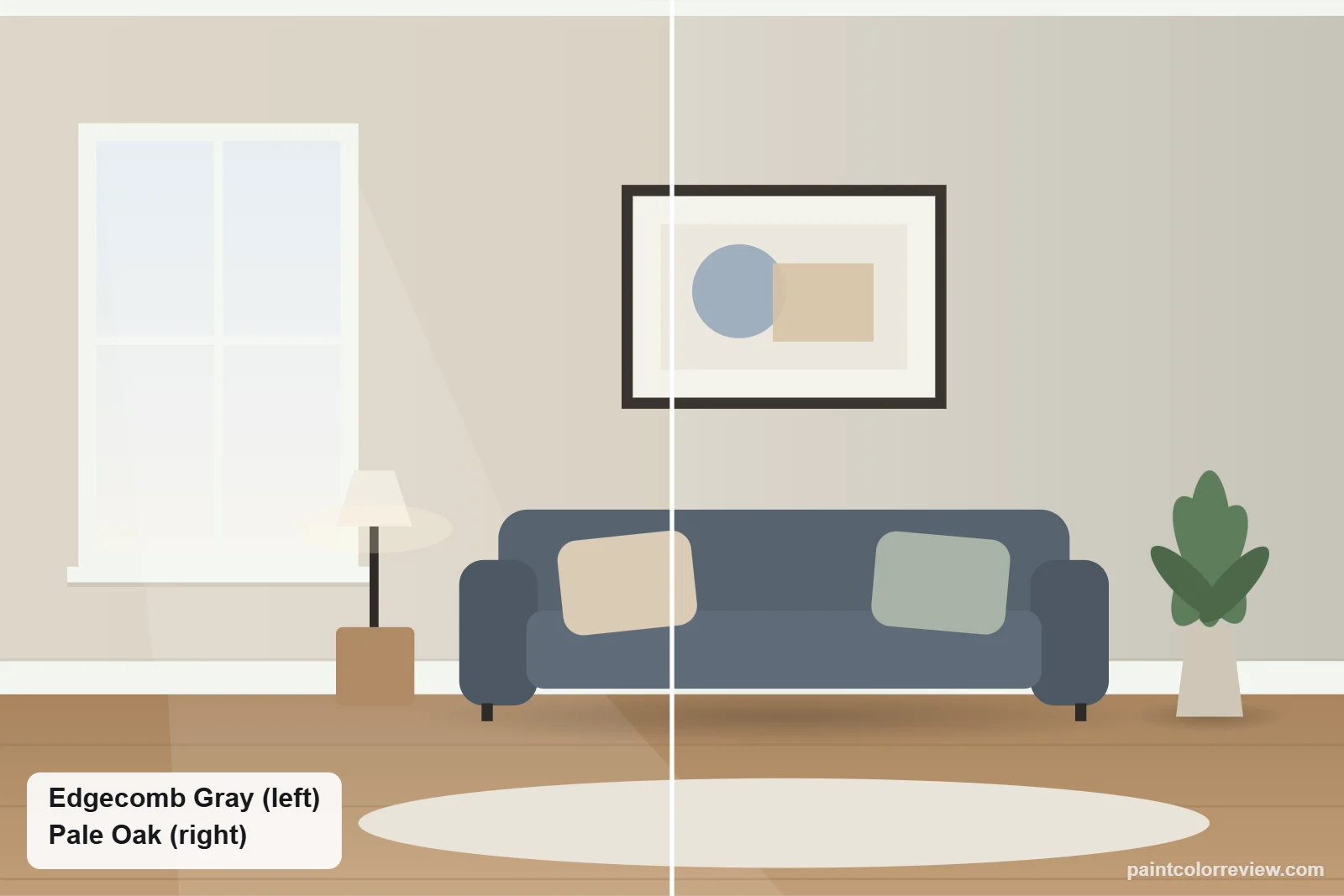
Edgecomb Gray (HC-173) and Pale Oak (OC-20) are Benjamin Moore's most popular light greiges. They look alike on a fan deck, but one leans beige and the other gray.
Side-by-side numbers
| Edgecomb Gray | Pale Oak | |
|---|---|---|
| Brand | Benjamin Moore | Benjamin Moore |
| Code | HC-173 | OC-20 |
| Hex | #D9D3C4 | #DDD9CE |
| RGB | 217, 211, 196 | 221, 217, 206 |
| LRV | 63.1 | 68.6 (lighter) |
| Yellow–blue (b*) | +8.1 (warmer) | +5.9 |
| Green–red (a*) | −0.5 | −0.5 |
| Difference (ΔE) | 2.2 |
Hex, RGB and LRV from the manufacturers' color records. CIELAB values and ΔE (CIEDE2000) calculated from those hex values.
Pale Oak is lighter (LRV 68.64 vs 63.09). The ΔE of 2.2 is visible side by side.
Undertones: Edgecomb Gray vs Pale Oak
Edgecomb Gray is clearly warmer (yellow–blue +8.1 vs +5.9) and reads closer to beige. Pale Oak is grayer. Both share a near-neutral green–red value (−0.5), so neither has a pink or green cast of its own.
How they compare in each light
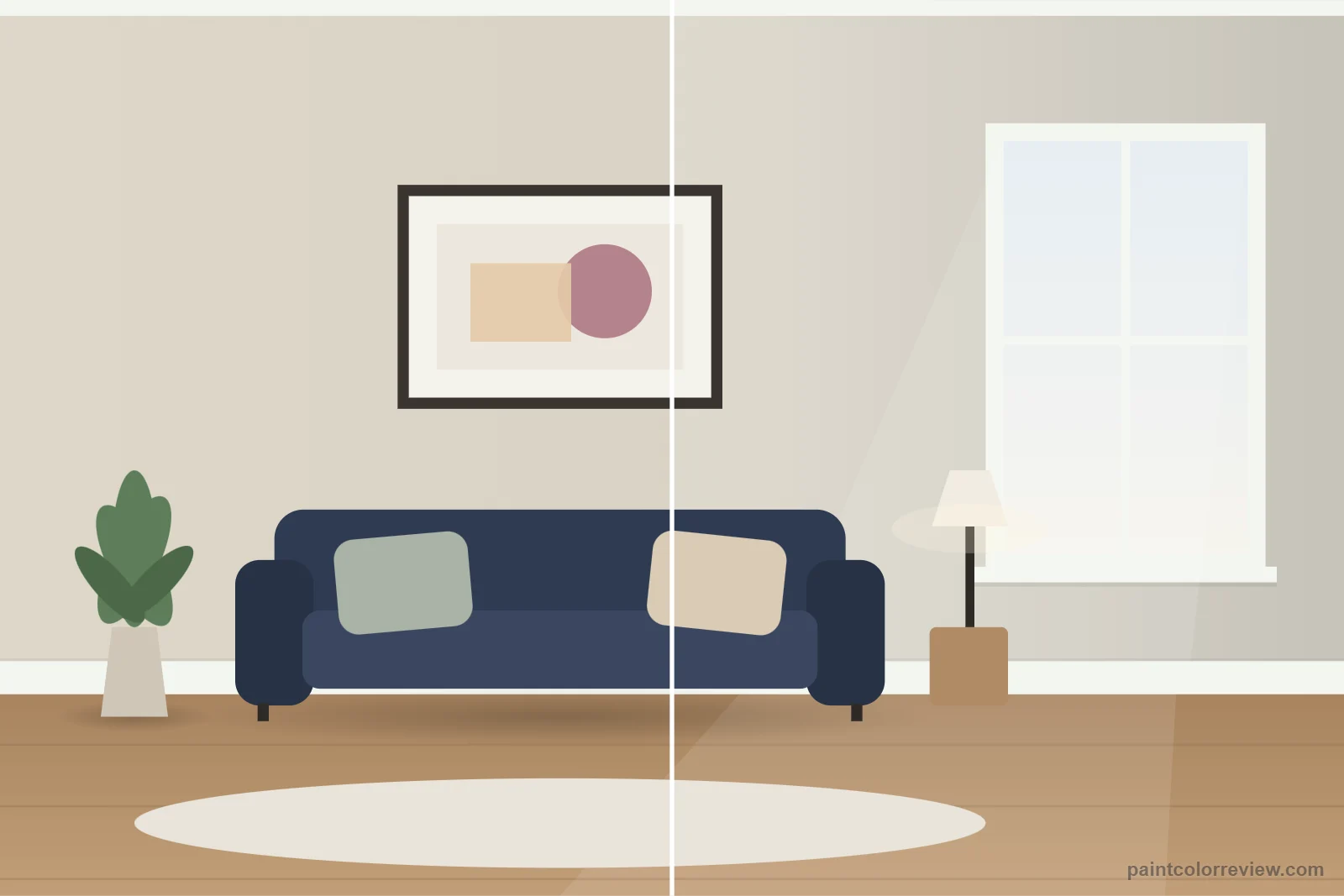
In north light Edgecomb Gray keeps more warmth while Pale Oak turns soft gray. In south light Edgecomb Gray can read distinctly beige.
Simulated from the manufacturer's color values. Always test samples in your own light.
Which one fits your room?
Choose Edgecomb Gray if…
- You want a warm, sandy greige that reads beige
- The room is north-facing and needs warmth
- Your finishes are warm wood, brass and cream
Choose Pale Oak if…
- You want a lighter greige that reads grayer
- You mix warm and cool finishes
- The room is on the dim side
Room by room: where Edgecomb Gray and Pale Oak each work
Living rooms
Edgecomb Gray is the warmer, slightly deeper greige (LRV 63.09), suited to living rooms with warm wood and beige textiles. Pale Oak is lighter (LRV 68.64) and less yellow, a better choice where you want a light, airy neutral.
Bedrooms
Edgecomb Gray gives a bedroom a soft, enveloping feel. Pale Oak keeps a smaller or north-facing bedroom lighter.
Kitchens and cabinets
Pale Oak works as a wall color with white cabinets and gray-veined quartz. Edgecomb Gray suits warm wood cabinets, cream subway tile and brass.
Bathrooms
Pale Oak is the safer choice in a windowless bathroom because it reflects more light. Edgecomb Gray can look beige-tan under warm bulbs.
Exteriors
Outdoors, sun lightens both. Edgecomb Gray is a popular warm greige for siding with white trim; Pale Oak can read as an off-white on a sunny facade.
Trim and colors to pair with each
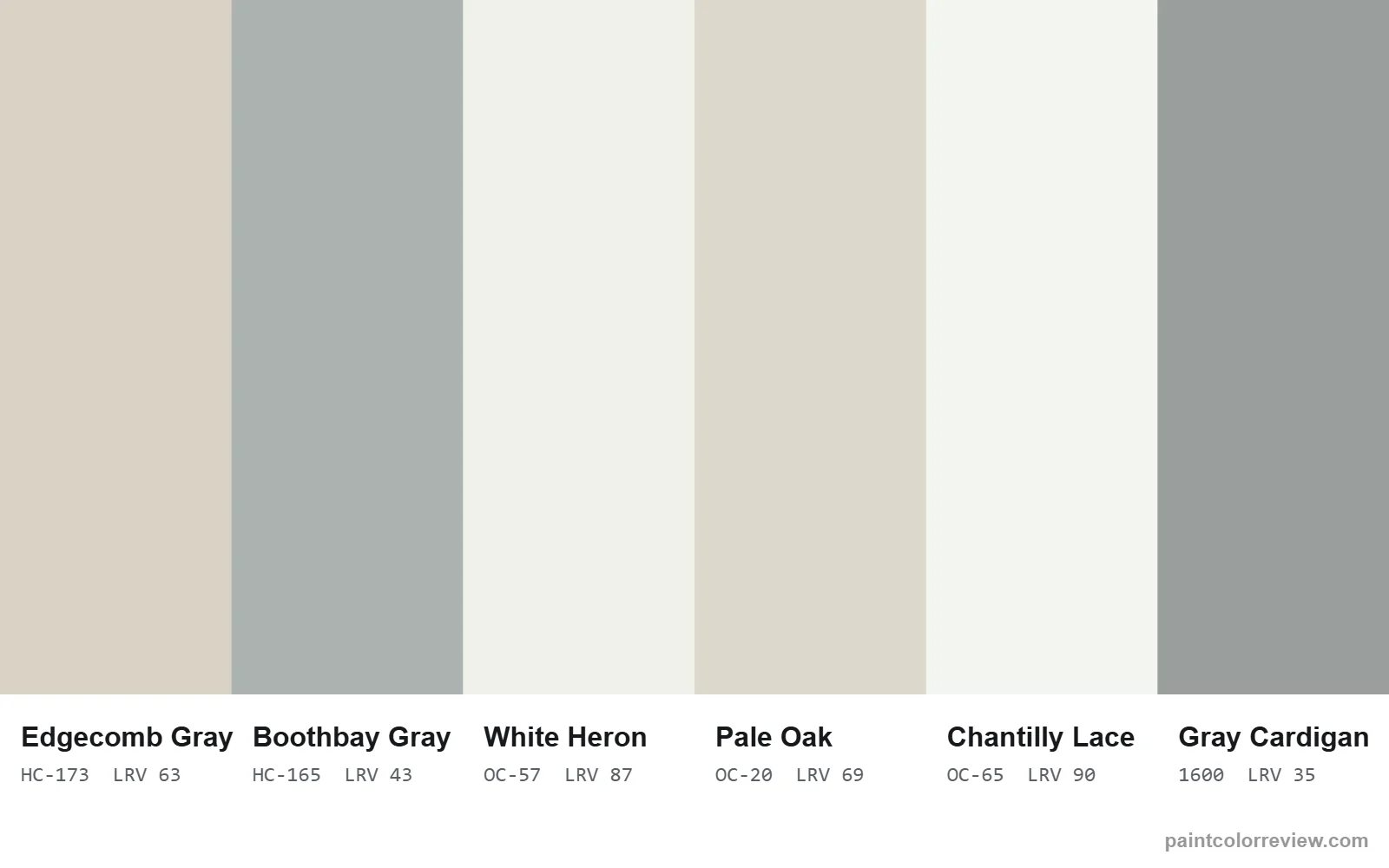
Benjamin Moore lists Pashmina (AF-100) and White Heron (OC-57) among the coordinating colors for Edgecomb Gray, and Chantilly Lace (OC-65) and Gray Cardigan (1600) for Pale Oak. Chantilly Lace gives Pale Oak a crisp trim; White Heron gives Edgecomb Gray a softer one.
Coordinating colors listed by the manufacturers:
- Edgecomb Gray: Boothbay Gray (HC-165), LRV 43.3; White Heron (OC-57), LRV 86.7; Pashmina (AF-100), LRV 44.2; Dove Wing (OC-18), LRV 77.5
- Pale Oak: Chantilly Lace (OC-65), LRV 90.0; Gray Cardigan (1600), LRV 34.7; Dinner Party (AF-300), LRV 8.4; Wrought Iron (2124-10), LRV 8.2
Can you use Edgecomb Gray and Pale Oak in the same house?
Yes. A difference of 2.2 is visible but harmonious: Pale Oak in brighter main spaces and Edgecomb Gray in a den or bedroom works well, with a shared white trim.
If neither is quite right
If Edgecomb Gray is too warm and Pale Oak too light, the table lists the nearest option in each direction.
| Direction | Color | Brand | LRV | ΔE to Edgecomb Gray | ΔE to Pale Oak |
|---|---|---|---|---|---|
| Lighter | Oyster White (SW 7637) | Sherwin-Williams | 72.5 | 2.5 | 1.3 |
| Darker | Useful Gray (SW 7050) | Sherwin-Williams | 59.1 | 2.3 | 3.7 |
| Warmer | Grecian Ivory (SW 7541) | Sherwin-Williams | 63.2 | 1.7 | 3.7 |
| Cooler | Winter Walk (SW 9628) | Sherwin-Williams | 66.4 | 2.6 | 1.3 |
Read the full reviews
Edgecomb Gray review · Pale Oak review
Edgecomb Gray vs Pale Oak FAQs
Is Pale Oak lighter than Edgecomb Gray?
Yes: LRV 68.64 against 63.09.
Which is warmer?
Edgecomb Gray (yellow–blue +8.1 vs +5.9).
Which is more beige?
Edgecomb Gray reads closer to beige; Pale Oak reads grayer.
Is Edgecomb Gray darker than Pale Oak?
Yes. Edgecomb Gray has an LRV of 63.09 against Pale Oak's 68.64.
Which one is warmer?
Edgecomb Gray, with more yellow (b* 8.1 against 5.9). Both sit at the same slight green lean on the green–red axis.
Which works better with gray floors?
Pale Oak. Edgecomb Gray can look beige next to cool gray flooring.