The four types of white paint
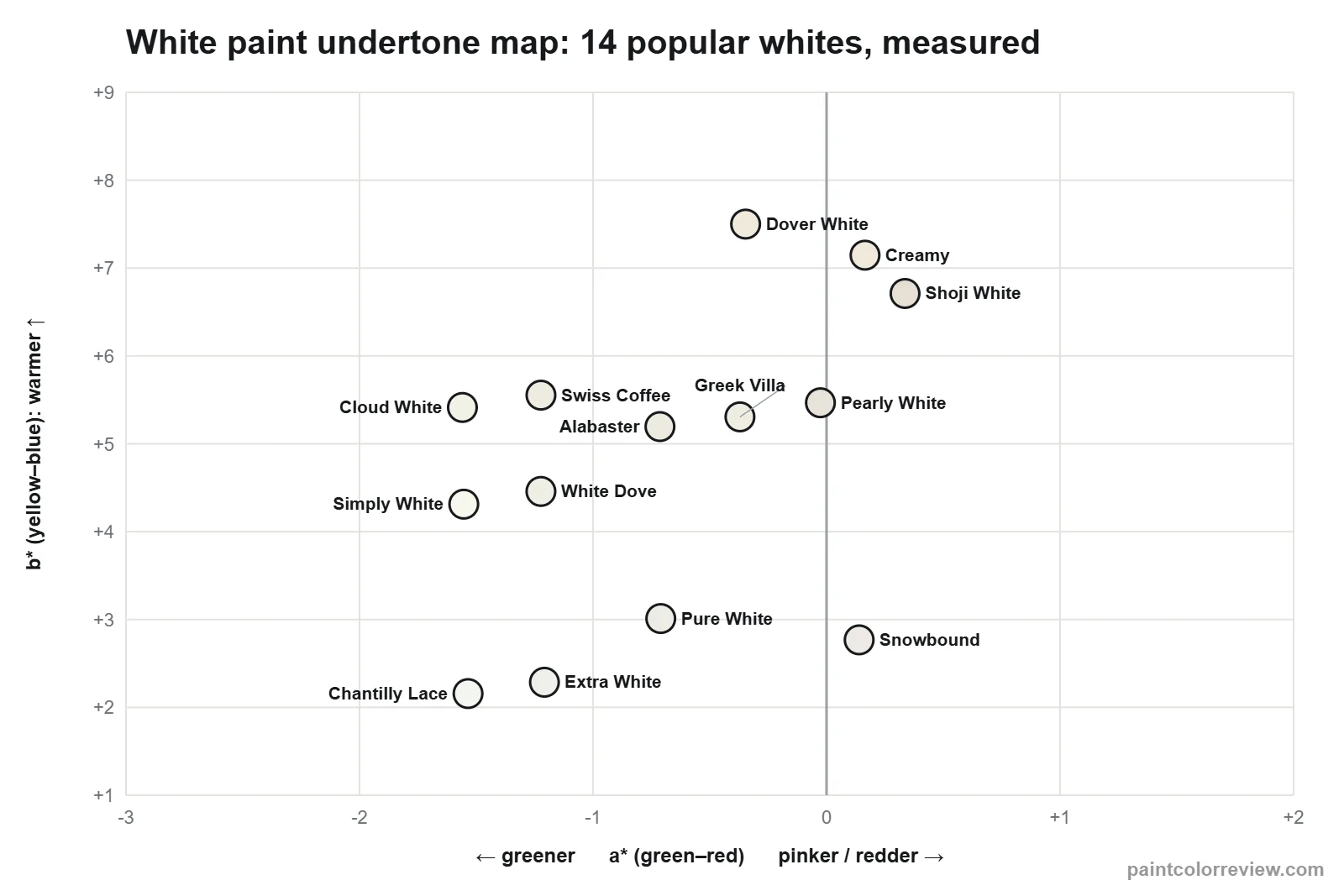
Whites differ in two ways: how bright they are (their LRV) and how warm they are. We sort them using each color's measured yellow–blue value (b*), where higher means warmer.
1. Bright, clean whites
Very little warmth (b* under about 3) and a high LRV. They look crisp and fresh, and are the classic choice for trim, ceilings and modern kitchens. Examples: Chantilly Lace (LRV 90.0), Extra White (85.9), Snowbound (82.8) and Pure White (84.0).
2. Soft, warm whites
A gentle warmth (b* about 4–6) that keeps rooms cozy without looking cream. These are the most popular whole-house whites: Simply White, Cloud White, Greek Villa, White Dove, Alabaster and Swiss Coffee.
3. Creamy whites
Clearly warm (b* 7 and above). They suit traditional homes, warm woods and soft lighting, but can look yellow next to cleaner whites. Examples: Creamy, Dover White and the deeper Antique White.
4. Off-whites
Lower LRVs (roughly 70–78) give these whites a soft, colored look that borders on greige. They are good for bright rooms where a true white would glare: Pearly White and Shoji White.
How to choose the right white
- Match the warmth to your fixed finishes. Cool stone and chrome suit clean whites; warm wood and brass suit soft or creamy whites.
- Match the brightness to your light. Dim, north-facing rooms need a high LRV; very sunny rooms can take a softer white.
- Test whites against each other. Whites only show their undertone beside another white, so compare two or three samples on the same wall.
For more on why whites shift, see our guide to LRV.
The best white paint for each job
Trim and doors
Trim needs to read as trim, so the cleanest, brightest whites work best: Chantilly Lace (LRV 90.0), Extra White (85.9) or Pure White (84.0) for a slightly softer line. Warm or creamy walls are the exception; there a stark white makes the wall look yellow, and a softer white such as Alabaster or White Dove is the better trim.
Ceilings
Ceilings sit in shadow, so a bright white with little warmth keeps them from looking gray: Chantilly Lace or Extra White in a flat finish. If the walls are a warm white, use the same white on the ceiling in flat so the room reads as one soft color.
Whole-house walls
Soft warm whites with an LRV in the low 80s are the easiest to live with: White Dove, Alabaster, Greek Villa and Swiss Coffee. They stay white in north light without looking stark in sunny rooms.
Kitchen cabinets
Match the cabinet white to the counter. With bright white quartz, use a clean white such as Simply White or Pure White, or the cabinets will look cream. With warm stone, wood or brass, White Dove or Alabaster looks more finished.
Exteriors
Strong sun makes every white look brighter, so many people pick a soft white rather than the brightest one: Alabaster, Pure White and Snowbound are all listed by Sherwin-Williams for exterior use. Very bright whites can glare on a sunny facade.
Pairing whites: walls and trim
Two whites together read as either one color, a gentle step, or crisp contrast, depending on how far apart they are. ΔE is the measured color difference: around 1 is hard to see, 2–3 is a soft visible step, above 3 is clear contrast.
| Walls | Trim | ΔE | Trim is lighter by | Look |
|---|---|---|---|---|
| Alabaster (SW 7008) | Pure White | 1.9 | 1.8 LRV | Soft, visible step |
| White Dove (OC-17) | Chantilly Lace | 2.6 | 6.9 LRV | Soft, visible step |
| Swiss Coffee (OC-45) | White Dove | 1.0 | 1.3 LRV | Tone-on-tone, almost seamless |
| Creamy (SW 7012) | Alabaster | 2.0 | 1.0 LRV | Soft, visible step |
| Shoji White (SW 7042) | Alabaster | 3.0 | 7.9 LRV | Clear, crisp contrast |
| Greek Villa (SW 7551) | Extra White | 3.0 | 1.7 LRV | Clear, crisp contrast |
| Snowbound (SW 7004) | Extra White | 2.2 | 3.1 LRV | Soft, visible step |
| White Dove (OC-17) | Simply White | 1.7 | 6.4 LRV | Soft, visible step |
| Pearly White (SW 7009) | Greek Villa | 2.0 | 6.9 LRV | Soft, visible step |
Are there any cool, blue whites here?
Not really. Every popular white on this page measures on the warm side of neutral (positive yellow–blue value), because a truly blue white looks cold in most homes. The coolest are Chantilly Lace (+2.2) and Extra White (+2.3), which read as clean, neutral whites rather than blue. Some whites lean very slightly green (negative green–red), such as Simply White and Cloud White (−1.6), which is part of why they look fresh next to greenery.
Why the same white looks different in each room
White walls reflect almost everything that hits them, so they take on the color of the light and the room. North light makes whites look grayer and cooler; south and west light makes them warmer. Green lawns, wood floors and colored walls reflect onto white walls nearby. That is why a white that looks perfect in the store can look yellow, gray or even green at home, and why testing two or three whites side by side on your own walls matters more for whites than for any other color. See the LRV guide for how brightness affects this.