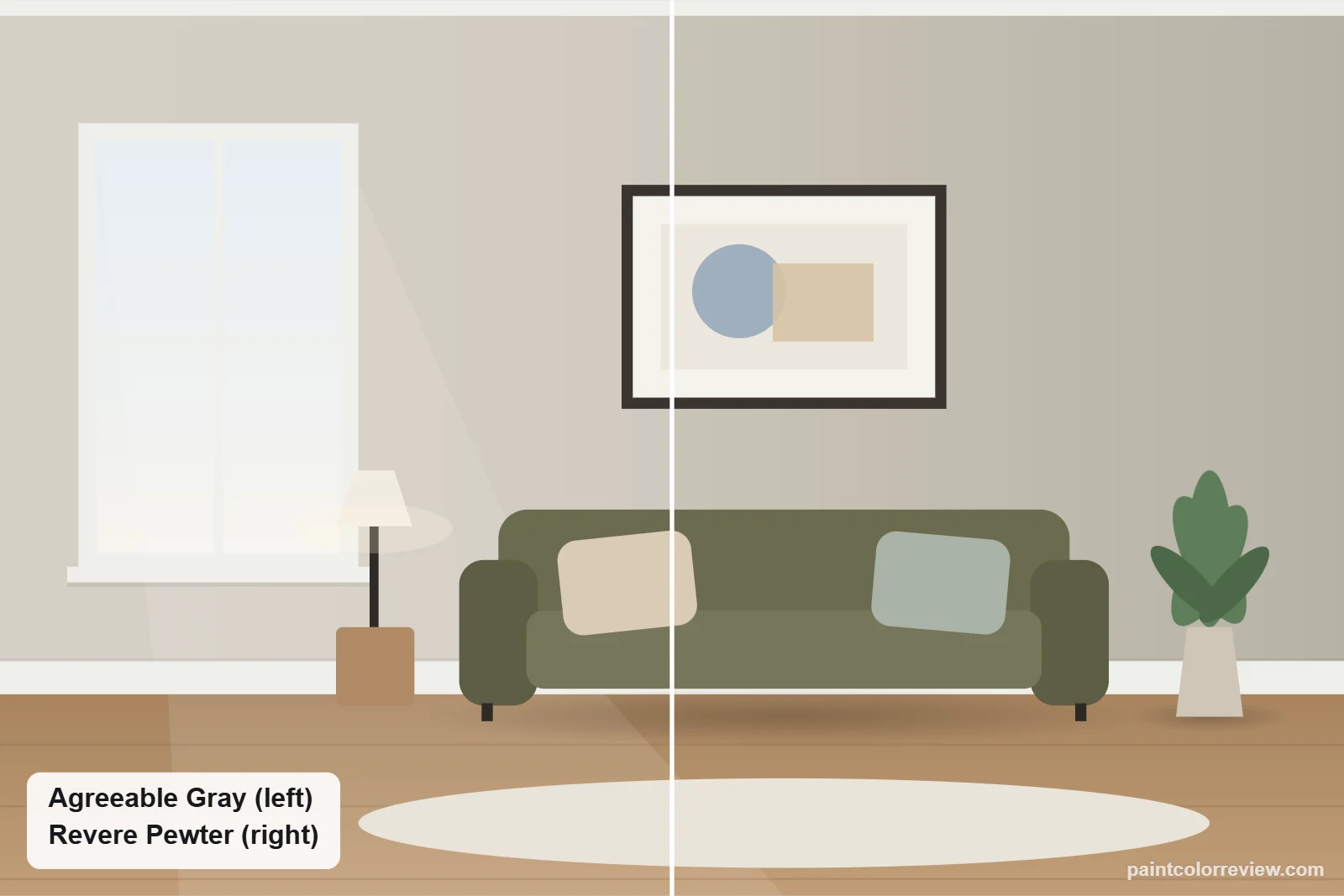
Agreeable Gray and Revere Pewter are the best-known greiges from Sherwin-Williams and Benjamin Moore. If you love one but can only buy the other brand, or are torn between them, these are the differences that matter.
Side-by-side numbers
| Agreeable Gray | Revere Pewter | |
|---|---|---|
| Brand | Sherwin-Williams | Benjamin Moore |
| Code | SW 7029 | HC-172 |
| Hex | #D1CBC1 | #CBC6B8 |
| RGB | 209, 203, 193 | 203, 198, 184 |
| LRV | 60.4 (lighter) | 55.1 |
| Yellow–blue (b*) | +5.7 | +7.6 (warmer) |
| Green–red (a*) | +0.3 | −0.7 |
| Difference (ΔE) | 2.5 |
Hex, RGB and LRV from the manufacturers' color records. CIELAB values and ΔE (CIEDE2000) calculated from those hex values.
Revere Pewter is noticeably darker (LRV 55.05 vs 60.4), and the ΔE of 2.5 is visible side by side. They are not substitutes for each other.
Undertones: Agreeable Gray vs Revere Pewter
Revere Pewter is the warmer, more beige of the two (yellow–blue +7.6 vs +5.7). It also has a faint green-gray lean (green–red −0.7), while Agreeable Gray is neutral. So Revere Pewter reads as a deeper, earthier greige; Agreeable Gray as a lighter, softer one.
How they compare in each light
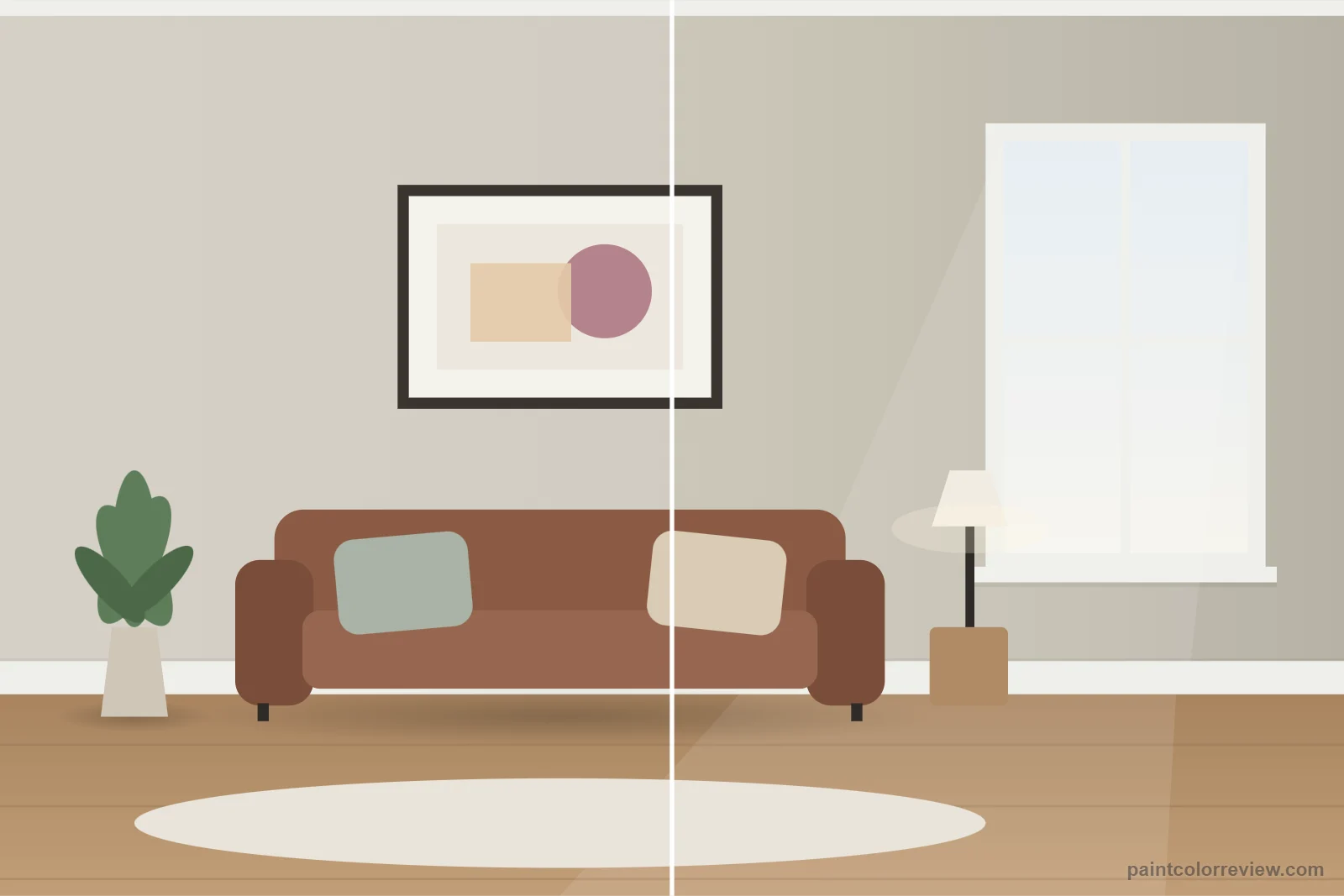
Revere Pewter needs light: in a dim north room its depth and slight green-gray side show more. Agreeable Gray stays lighter in the same room. In bright south light both look warm, with Revere Pewter richer.
Simulated from the manufacturer's color values. Always test samples in your own light.
Which one fits your room?
Choose Agreeable Gray if…
- You want a lighter greige, especially in dimmer rooms
- You prefer a softer, grayer neutral
- You are buying Sherwin-Williams
Choose Revere Pewter if…
- You want more depth and a classic, earthy greige
- Your rooms get plenty of light
- You are buying Benjamin Moore
Room by room: where Agreeable Gray and Revere Pewter each work
Living rooms
Revere Pewter gives a living room more depth and a slightly earthier feel, which flatters traditional furniture, leather and wood. Agreeable Gray is lighter and more neutral, a better fit for smaller living rooms or ones with limited daylight.
Bedrooms
Revere Pewter's deeper value makes a bedroom feel enclosed and calm; in a small north-facing bedroom that can tip into dull. Agreeable Gray keeps a small bedroom feeling open.
Kitchens and cabinets
On lower cabinets or an island, Revere Pewter's depth gives contrast against white uppers and counters. Agreeable Gray works better as an overall wall color in kitchens with white or light gray cabinets.
Bathrooms
In a windowless bathroom Revere Pewter can look heavy under weak lighting. Agreeable Gray is the safer choice unless the room is well lit.
Exteriors
Agreeable Gray is rated by Sherwin-Williams for exterior use. Outdoors, Revere Pewter's extra depth helps it hold a gray-greige look in full sun, where lighter colors wash out. Test a large sample board against your roof and brick before committing.
Trim and colors to pair with each
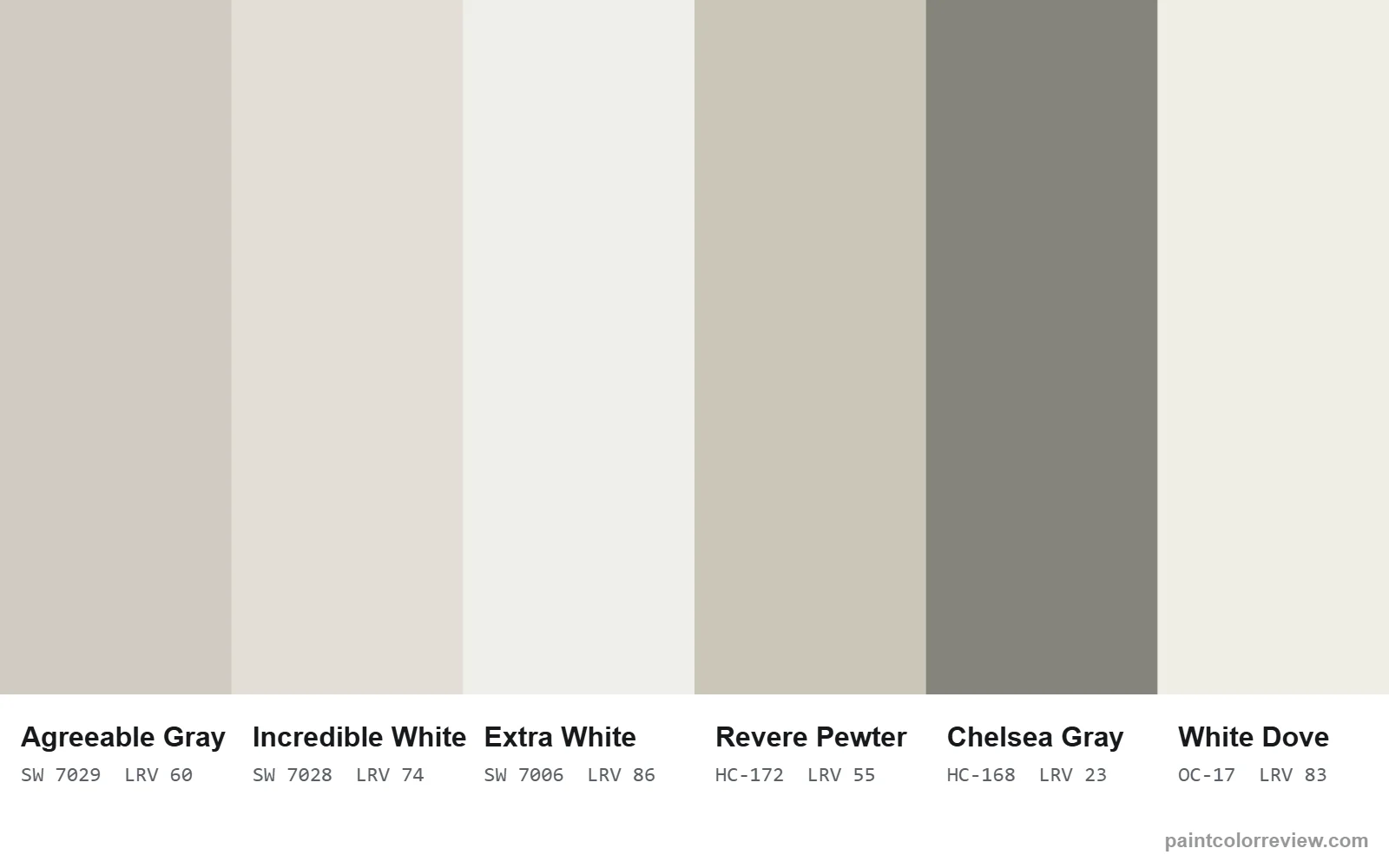
Benjamin Moore lists White Dove (OC-17) and Chelsea Gray (HC-168) among the coordinating colors for Revere Pewter, which gives you a ready trim white and a deeper accent. For Agreeable Gray, Sherwin-Williams lists Extra White (SW 7006). Mixing brands is fine as long as you sample them together.
Coordinating colors listed by the manufacturers:
- Agreeable Gray: Incredible White (SW 7028), LRV 73.6; Extra White (SW 7006), LRV 85.9; Coral Rose (SW 9004), LRV 28.3
- Revere Pewter: Chelsea Gray (HC-168), LRV 23.3; White Dove (OC-17), LRV 83.2; Sparrow (AF-720), LRV 21.1; Fog Mist (OC-31), LRV 70.2
Can you use Agreeable Gray and Revere Pewter in the same house?
Yes. At a difference of 2.5 they read as related but distinct: Revere Pewter as the deeper, slightly greener greige and Agreeable Gray as the lighter one. A common approach is Agreeable Gray in main living areas and Revere Pewter in a den, dining room or on an island.
If neither is quite right
If you like the warmth of both but want something lighter or deeper, or slightly warmer or cooler, the table gives the nearest color in each direction.
| Direction | Color | Brand | LRV | ΔE to Agreeable Gray | ΔE to Revere Pewter |
|---|---|---|---|---|---|
| Lighter | Modern Gray (SW 7632) | Sherwin-Williams | 62.5 | 1.2 | 3.2 |
| Darker | Skyline Steel (SW 1015) | Sherwin-Williams | 52.3 | 3.1 | 2.3 |
| Warmer | Mushroom (SW 9587) | Sherwin-Williams | 57.4 | 2.7 | 1.9 |
| Cooler | Mercurial (SW 9550) | Sherwin-Williams | 61.0 | 1.9 | 4.1 |
Read the full reviews
Agreeable Gray review · Revere Pewter review
Agreeable Gray vs Revere Pewter FAQs
Is Revere Pewter darker than Agreeable Gray?
Yes: LRV 55.05 against 60.4.
Is Agreeable Gray the same as Revere Pewter?
No. They are close relatives but visibly different (ΔE 2.5); Revere Pewter is darker and warmer.
Which is warmer?
Revere Pewter (yellow–blue +7.6 vs +5.7).
Which one has a green undertone?
Revere Pewter leans very slightly green (a* –0.7). Agreeable Gray sits close to neutral on the green–red axis (+0.3).
What is the Sherwin-Williams equivalent of Revere Pewter?
No Sherwin-Williams color is an exact match. Our Revere Pewter review lists the closest matches by measured difference.