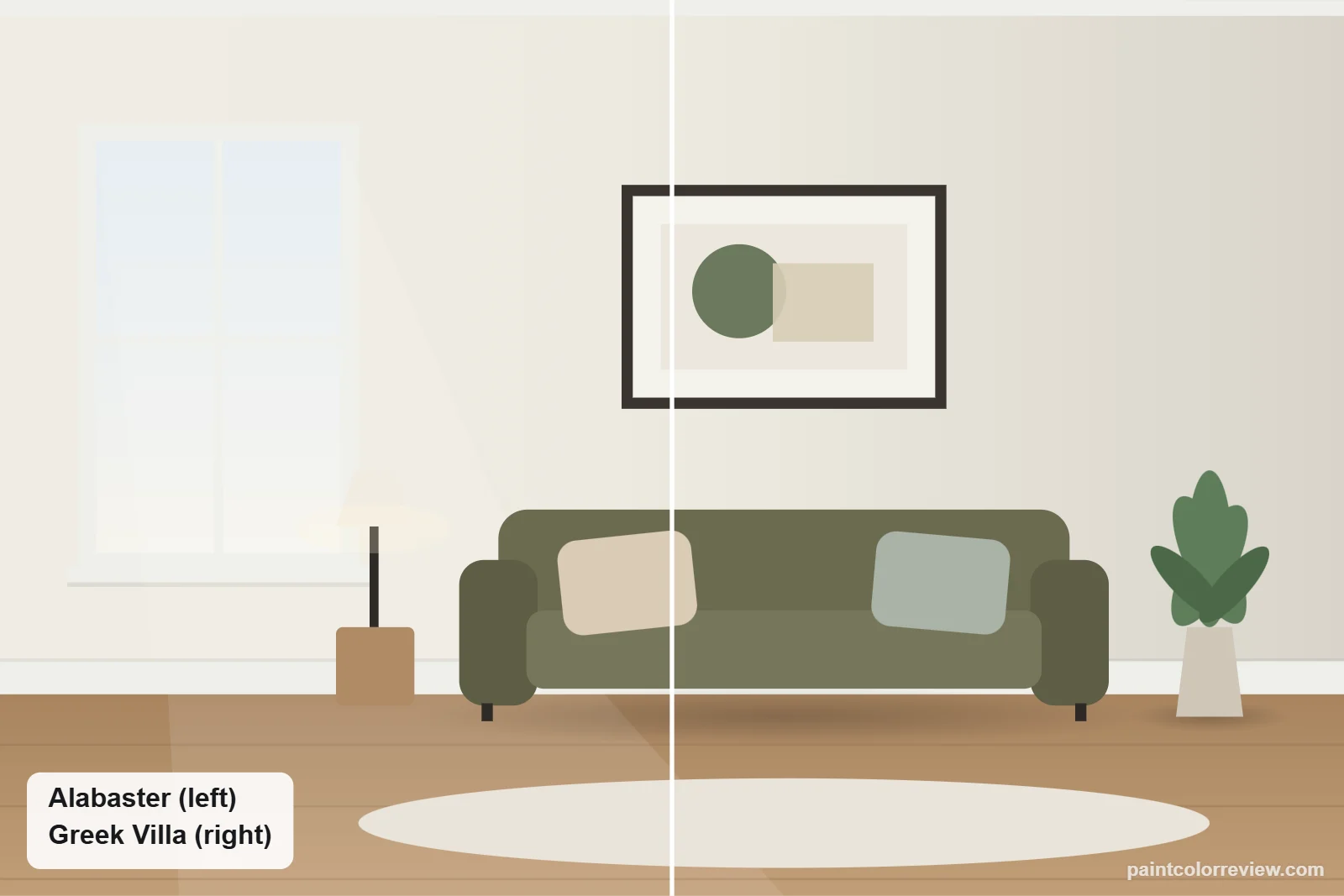
Alabaster (SW 7008) and Greek Villa (SW 7551) are two of Sherwin-Williams' most popular warm whites, and they are almost twins. The difference comes down to brightness.
Side-by-side numbers
| Alabaster | Greek Villa | |
|---|---|---|
| Brand | Sherwin-Williams | Sherwin-Williams |
| Code | SW 7008 | SW 7551 |
| Hex | #EDEAE0 | #F0ECE2 |
| RGB | 237, 234, 224 | 240, 236, 226 |
| LRV | 82.2 | 84.2 (lighter) |
| Yellow–blue (b*) | +5.2 | +5.3 (warmer) |
| Green–red (a*) | −0.7 | −0.4 |
| Difference (ΔE) | 0.7 |
Hex, RGB and LRV from the manufacturers' color records. CIELAB values and ΔE (CIEDE2000) calculated from those hex values.
With a ΔE of 0.7, most people can't tell them apart on a wall without seeing them side by side. Greek Villa is a little brighter (LRV 84.2 vs 82.2).
Undertones: Alabaster vs Greek Villa
Their warmth is almost identical (yellow–blue +5.3 for Greek Villa, +5.2 for Alabaster). Alabaster has a slightly stronger lean away from pink (green–red −0.7 vs −0.4), which can make it look a touch more muted beside Greek Villa.
How they compare in each light
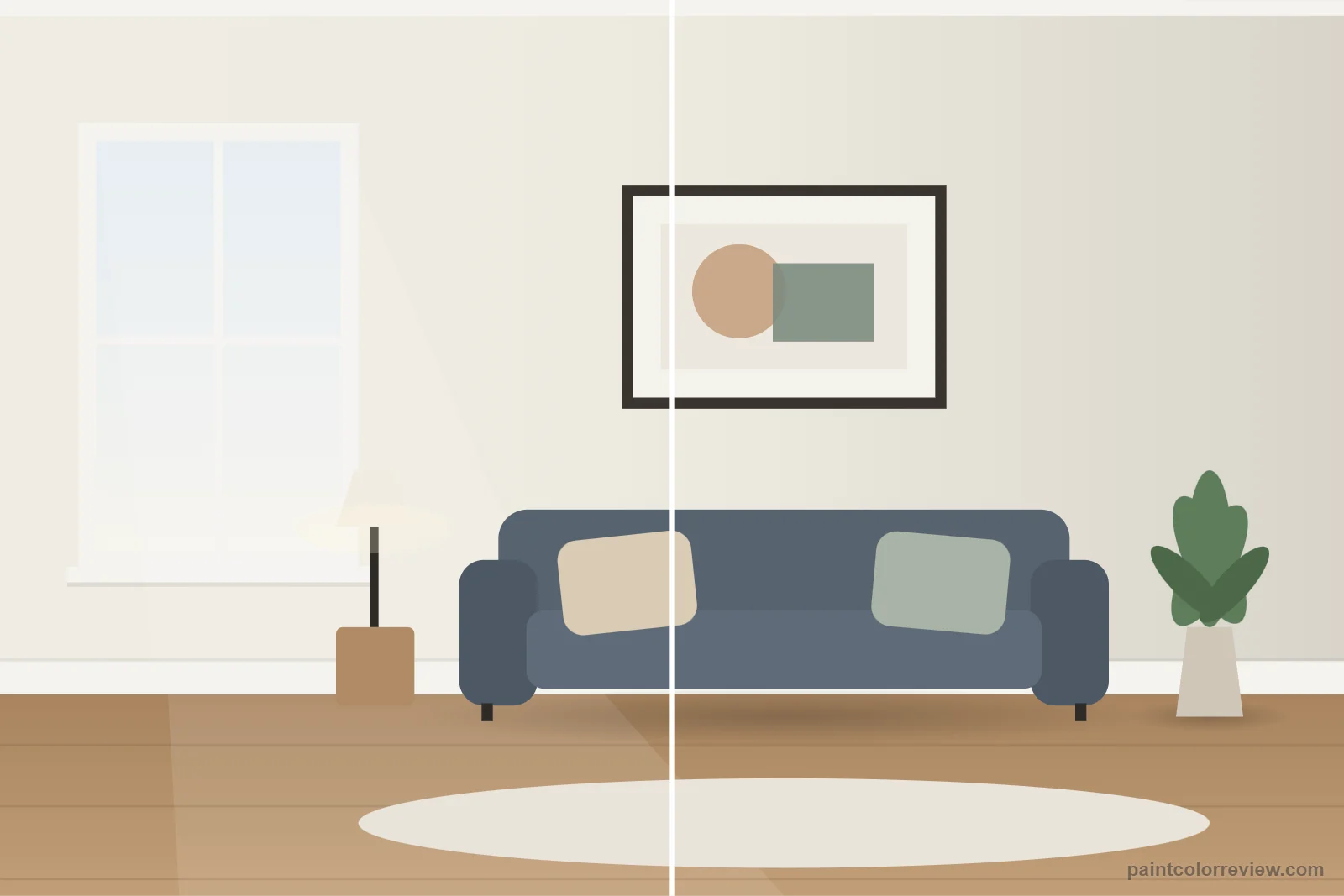
In every direction they move together. The two-point LRV difference matters most in dim north rooms, where Greek Villa stays slightly brighter.
Simulated from the manufacturer's color values. Always test samples in your own light.
Which one fits your room?
Choose Alabaster if…
- You want a soft white that feels a little more muted
- Your room is bright and you want to avoid glare
- You like a warm white that reads close to greige trim
Choose Greek Villa if…
- You want the brighter of the two
- Your room is dim or north-facing
- You want a warm white that still reads clearly white
Room by room: where Alabaster and Greek Villa each work
Living rooms
With a measured difference of only 0.7, most people cannot tell these two apart on a living room wall. Greek Villa is the slightly brighter of the two (LRV 84.2 against 82.2), which gives it a small edge in a living room with limited daylight. Alabaster has a fractionally creamier look in warm evening light.
Bedrooms
Either gives a bedroom a soft, warm white that never looks stark. In a north-facing bedroom, both stay warm rather than turning gray, which is the main reason people choose them over a cleaner white.
Kitchens and cabinets
Both are popular cabinet whites because they look warm without reading yellow. Against bright white quartz or subway tile, both will look slightly creamy; against warm marble or butcher block they read as plain white. If you already have Alabaster cabinets, Greek Villa walls will look like the same color.
Bathrooms
In a small bathroom under warm 2700K bulbs, both lean creamy. Under 3000–3500K bulbs they read as a soft white. The choice of bulb matters far more here than the choice between these two colors.
Exteriors
Sherwin-Williams rates both for exterior use. Outdoors, strong sun makes both read as a soft white; Alabaster is a common pick for modern farmhouse siding with black windows, and Greek Villa does the same job.
Trim and colors to pair with each
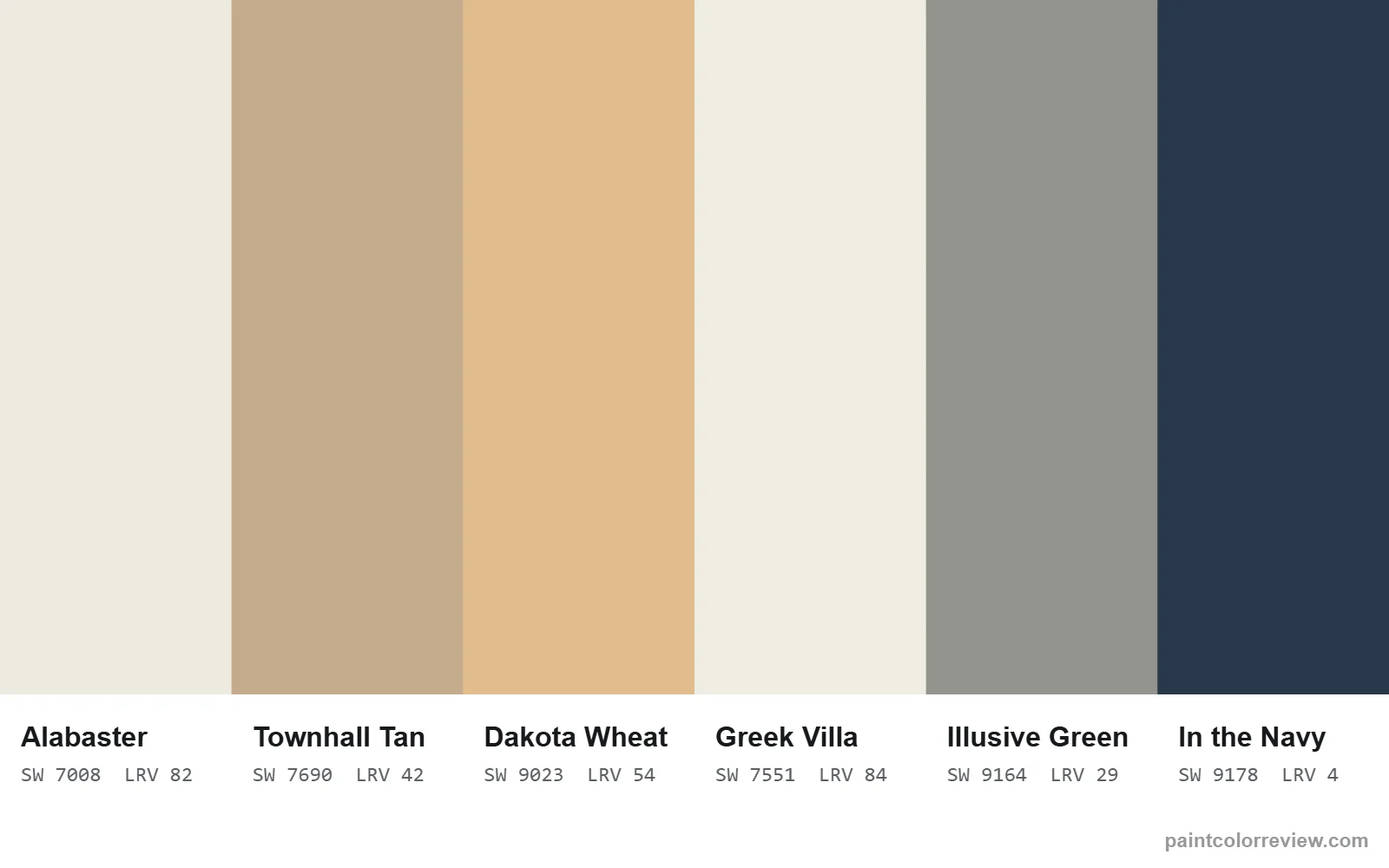
Because they are so close, both share the same trim logic: use the wall color itself for trim in a lower-contrast scheme, or a brighter white such as Extra White (SW 7006) for crisp contrast. Sherwin-Williams lists warm tans for Alabaster, including Townhall Tan (SW 7690), and stronger accents for Greek Villa, including In the Navy (SW 9178), a deep navy that works on a front door or island.
Coordinating colors listed by the manufacturers:
- Alabaster: Townhall Tan (SW 7690), LRV 42.3; Dakota Wheat (SW 9023), LRV 54.2
- Greek Villa: Illusive Green (SW 9164), LRV 29.3; In the Navy (SW 9178), LRV 3.7
Can you use Alabaster and Greek Villa in the same house?
Yes, easily. At ΔE 0.7 they behave as one color. You can put Greek Villa on walls and Alabaster on trim or cabinets, or the reverse, and the change will be barely visible. That is useful when one product line or sheen is available in one color but not the other.
If neither is quite right
If both read too creamy in your light, move to a cleaner white; if both look too stark, step down to a deeper warm white. The table gives the nearest option in each direction.
| Direction | Color | Brand | LRV | ΔE to Alabaster | ΔE to Greek Villa |
|---|---|---|---|---|---|
| Lighter | Cheviot (SW 9503) | Sherwin-Williams | 88.7 | 1.8 | 1.3 |
| Darker | Seapearl (OC-19) | Benjamin Moore | 76.4 | 1.4 | 1.9 |
| Warmer | Classic Light Buff (SW 0050) | Sherwin-Williams | 82.5 | 1.9 | 1.8 |
| Cooler | Cloud Cover (OC-25) | Benjamin Moore | 80.3 | 1.2 | 1.8 |
Read the full reviews
Alabaster review · Greek Villa review
Alabaster vs Greek Villa FAQs
Is Greek Villa warmer than Alabaster?
No, their warmth is almost identical. Greek Villa is slightly brighter.
Can you tell Alabaster and Greek Villa apart?
Barely. Their ΔE is 0.7, so most people only see a difference side by side.
Which is better for a north-facing room?
Greek Villa, because its higher LRV keeps the room a little brighter.
Can you tell Alabaster and Greek Villa apart on a wall?
Usually not. Their measured difference is 0.7, below what most people notice on a painted wall. Side by side on large samples, Greek Villa looks very slightly brighter.
Which is better for kitchen cabinets?
Both work equally well. Choose the one that suits your sheen and product availability rather than the color itself.