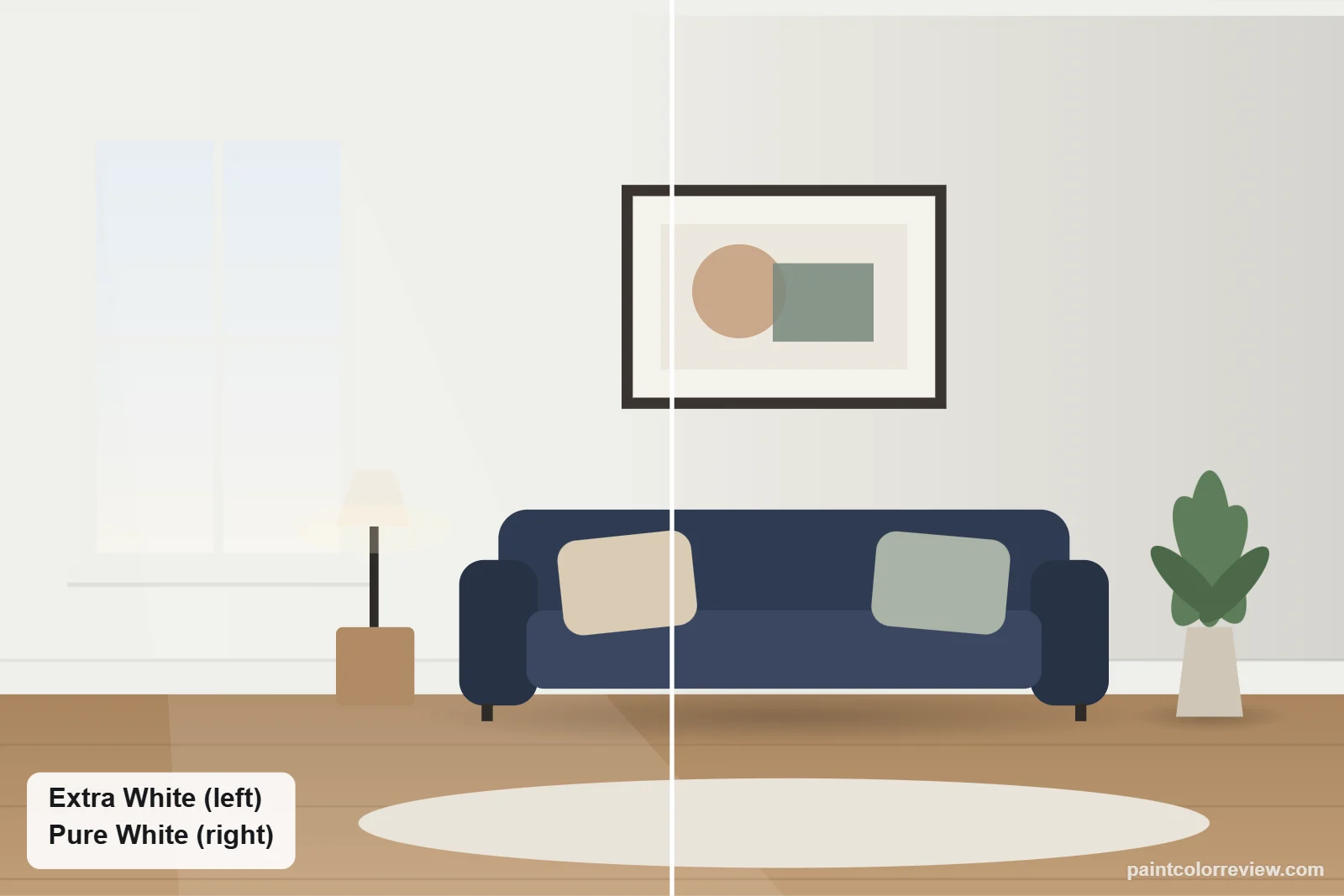
Extra White (SW 7006) and Pure White (SW 7005) are Sherwin-Williams' two go-to clean whites. Both are bright and fresh; the differences are small but matter for trim and ceilings.
Side-by-side numbers
| Extra White | Pure White | |
|---|---|---|
| Brand | Sherwin-Williams | Sherwin-Williams |
| Code | SW 7006 | SW 7005 |
| Hex | #EEEFEA | #EDECE6 |
| RGB | 238, 239, 234 | 237, 236, 230 |
| LRV | 85.9 (lighter) | 84.0 |
| Yellow–blue (b*) | +2.3 | +3.0 (warmer) |
| Green–red (a*) | −1.2 | −0.7 |
| Difference (ΔE) | 1.1 |
Hex, RGB and LRV from the manufacturers' color records. CIELAB values and ΔE (CIEDE2000) calculated from those hex values.
Extra White is the brighter one (LRV 85.9 vs 84.0). The ΔE of 1.1 means they look very close on a wall.
Undertones: Extra White vs Pure White
Extra White is the cleaner, slightly cooler white (yellow–blue +2.3, green–red −1.2). Pure White has a touch more warmth (+3.0) and is closer to neutral on green–red (−0.7), so it looks a little softer.
How they compare in each light
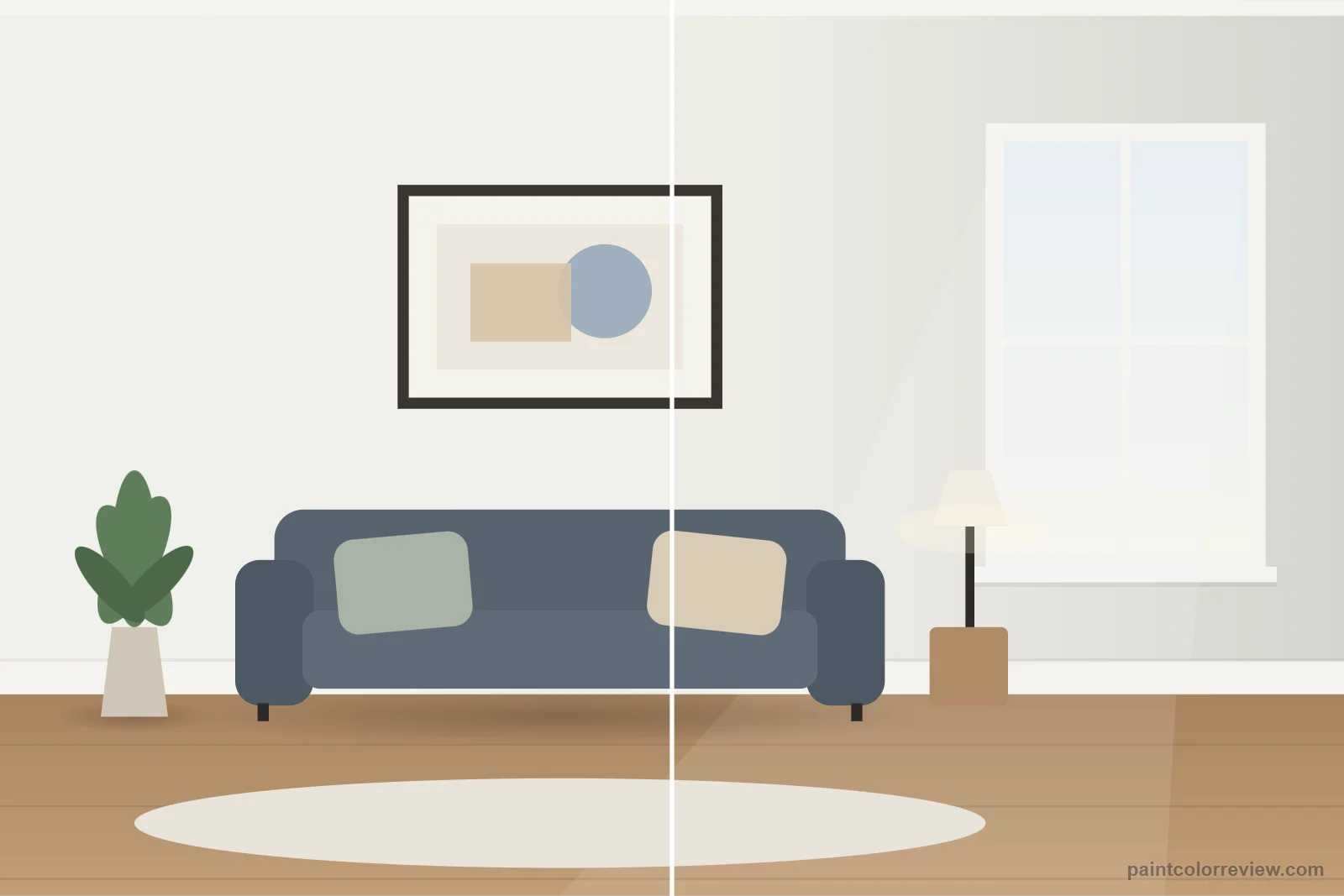
Both stay white in every direction. In north light Extra White can look slightly cool; Pure White keeps a hint of warmth.
Simulated from the manufacturer's color values. Always test samples in your own light.
Which one fits your room?
Choose Extra White if…
- You want the brightest, crispest white
- You need trim and ceilings to look sharp against color
- Your style is modern with cool finishes
Choose Pure White if…
- You want a clean white that is a touch softer
- You plan one white for walls, trim and ceilings
- Your home mixes warm and cool finishes
Room by room: where Extra White and Pure White each work
Living rooms
Extra White is a clean, bright white that suits modern living rooms and gallery-style walls. Pure White is softer, with a touch more warmth, and avoids looking stark in a large, sunny room. The LRV gap is small (85.9 against 84), so the difference is in tone rather than brightness.
Bedrooms
Pure White is the more relaxed bedroom white. Extra White can look slightly cool in a north-facing bedroom, especially in winter light.
Kitchens and cabinets
Both are frequent cabinet choices. Extra White matches bright white quartz and white appliances closely; Pure White looks better next to warmer counters and wood floors, where Extra White can look blue by comparison.
Bathrooms
Extra White suits a crisp, spa-like bathroom with white tile and chrome. Pure White is more forgiving under warm bulbs and with cream or beige tile.
Exteriors
Both are rated for exterior use. Outdoors, Extra White can look very bright in full sun; Pure White is the softer exterior white and is less likely to glare on a sunny south-facing facade.
Trim and colors to pair with each
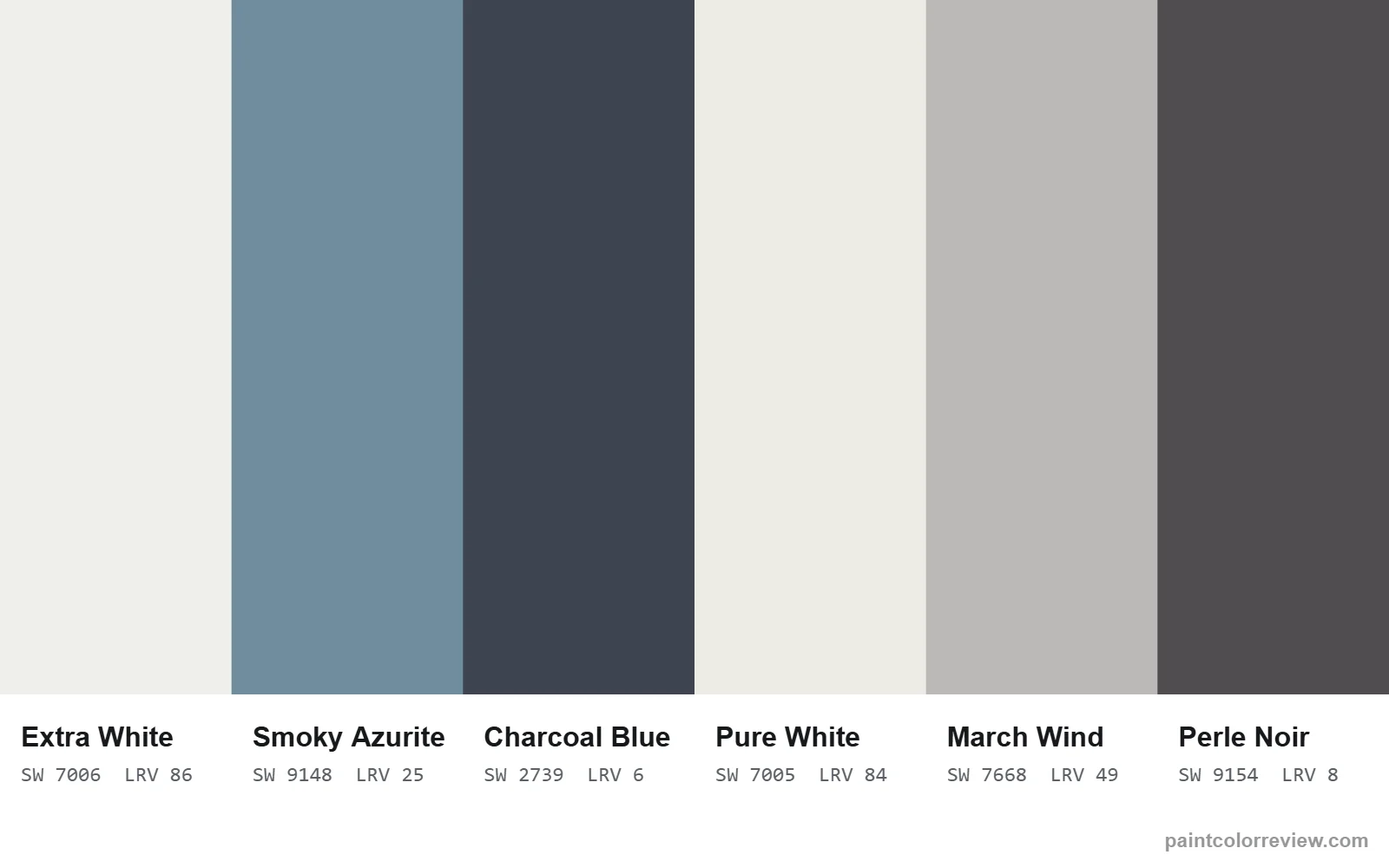
Extra White is itself one of the most popular trim whites, and Sherwin-Williams lists it as a coordinating color for Agreeable Gray, among others. For accents, the brand lists deep blues for Extra White, including Charcoal Blue (SW 2739), and March Wind (SW 7668) and Perle Noir (SW 9154) for Pure White.
Coordinating colors listed by the manufacturers:
- Extra White: Smoky Azurite (SW 9148), LRV 25.1; Charcoal Blue (SW 2739), LRV 5.7
- Pure White: March Wind (SW 7668), LRV 48.7; Perle Noir (SW 9154), LRV 7.5
Can you use Extra White and Pure White in the same house?
Yes. Pure White walls with Extra White trim is a common, low-risk combination: the trim reads a little cleaner without obvious contrast. At a difference of 1.1, they are too close to use as deliberate contrast.
If neither is quite right
If Extra White is too stark and Pure White still too bright, step down to a deeper white; if you want something warmer, the table shows the nearest option.
| Direction | Color | Brand | LRV | ΔE to Extra White | ΔE to Pure White |
|---|---|---|---|---|---|
| Lighter | White Snow (SW 9541) | Sherwin-Williams | 90.3 | 1.5 | 1.7 |
| Darker | Cloud Cover (OC-25) | Benjamin Moore | 80.3 | 2.1 | 1.3 |
| Warmer | White Dove (OC-17) | Benjamin Moore | 83.2 | 1.9 | 1.4 |
Read the full reviews
Extra White review · Pure White review
Extra White vs Pure White FAQs
Which is whiter, Extra White or Pure White?
Extra White is slightly brighter and cleaner (LRV 85.9 vs 84.0).
Is Pure White warm or cool?
Very slightly warm (yellow–blue +3.0), softer than Extra White.
Which is better for trim?
Extra White for maximum crispness; Pure White for a softer, all-over look.
Is Extra White brighter than Pure White?
Slightly. Extra White has an LRV of 85.9 against Pure White's 84, and it reads cleaner because it has less yellow.
Does Extra White look blue?
It can look slightly cool next to warm colors or in north light, but it has no strong blue undertone. Its yellow–blue value is +2.3, still on the warm side.