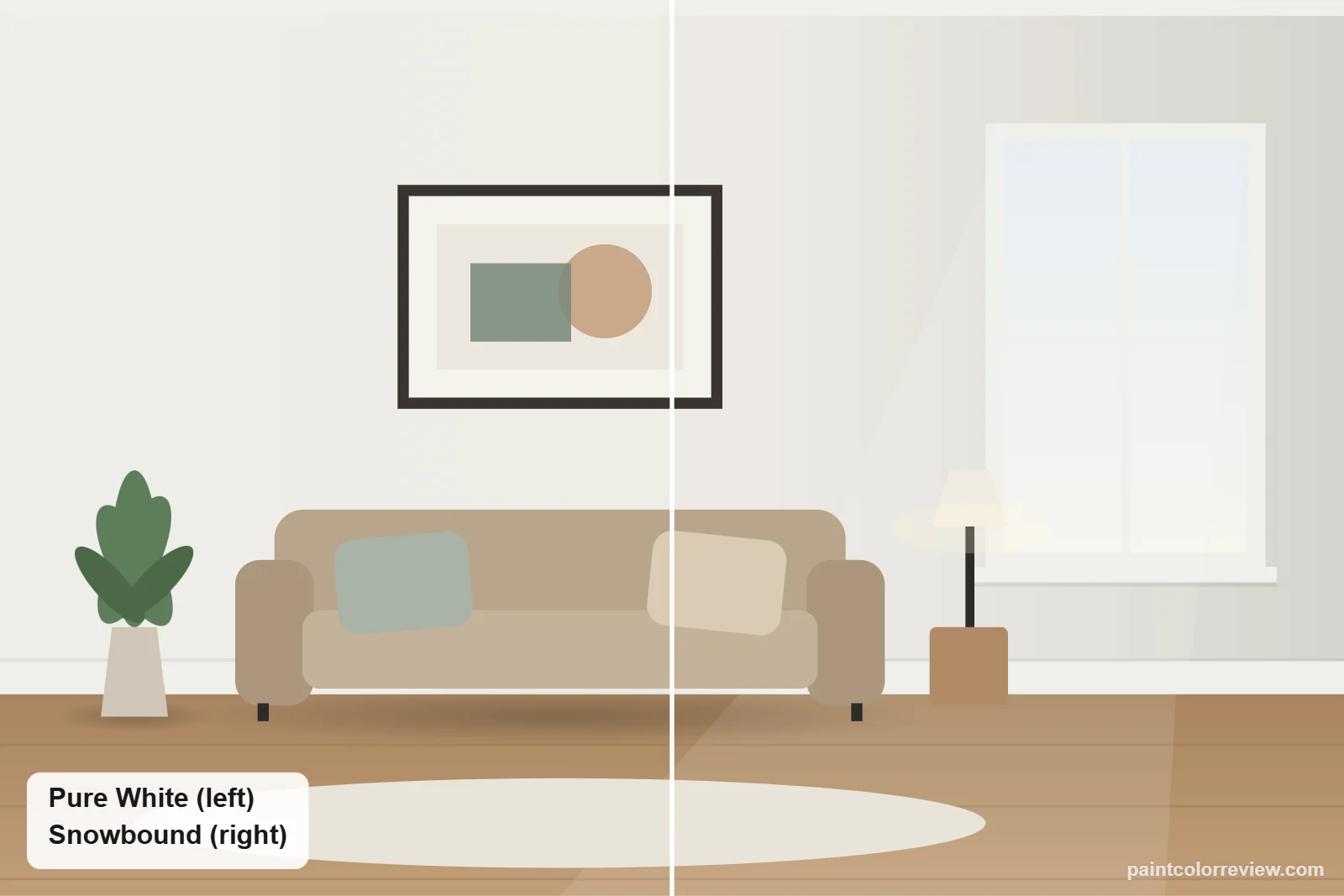
Pure White (SW 7005) and Snowbound (SW 7004) are both clean, near-neutral Sherwin-Williams whites. They are close, but they lean in slightly different directions.
Side-by-side numbers
| Pure White | Snowbound | |
|---|---|---|
| Brand | Sherwin-Williams | Sherwin-Williams |
| Code | SW 7005 | SW 7004 |
| Hex | #EDECE6 | #EDEAE5 |
| RGB | 237, 236, 230 | 237, 234, 229 |
| LRV | 84.0 (lighter) | 82.8 |
| Yellow–blue (b*) | +3.0 (warmer) | +2.8 |
| Green–red (a*) | −0.7 | +0.1 |
| Difference (ΔE) | 1.3 |
Hex, RGB and LRV from the manufacturers' color records. CIELAB values and ΔE (CIEDE2000) calculated from those hex values.
Pure White is a little brighter (LRV 84.0 vs 82.8). The ΔE of 1.3 means they look very similar on a wall.
Undertones: Pure White vs Snowbound
Both have little warmth (yellow–blue +3.0 and +2.8). The difference is on the green–red axis: Pure White leans faintly away from pink (−0.7), while Snowbound is neutral to a hair warm (+0.1). Beside each other, Snowbound can look a touch softer and more "putty", Pure White a touch cleaner.
How they compare in each light
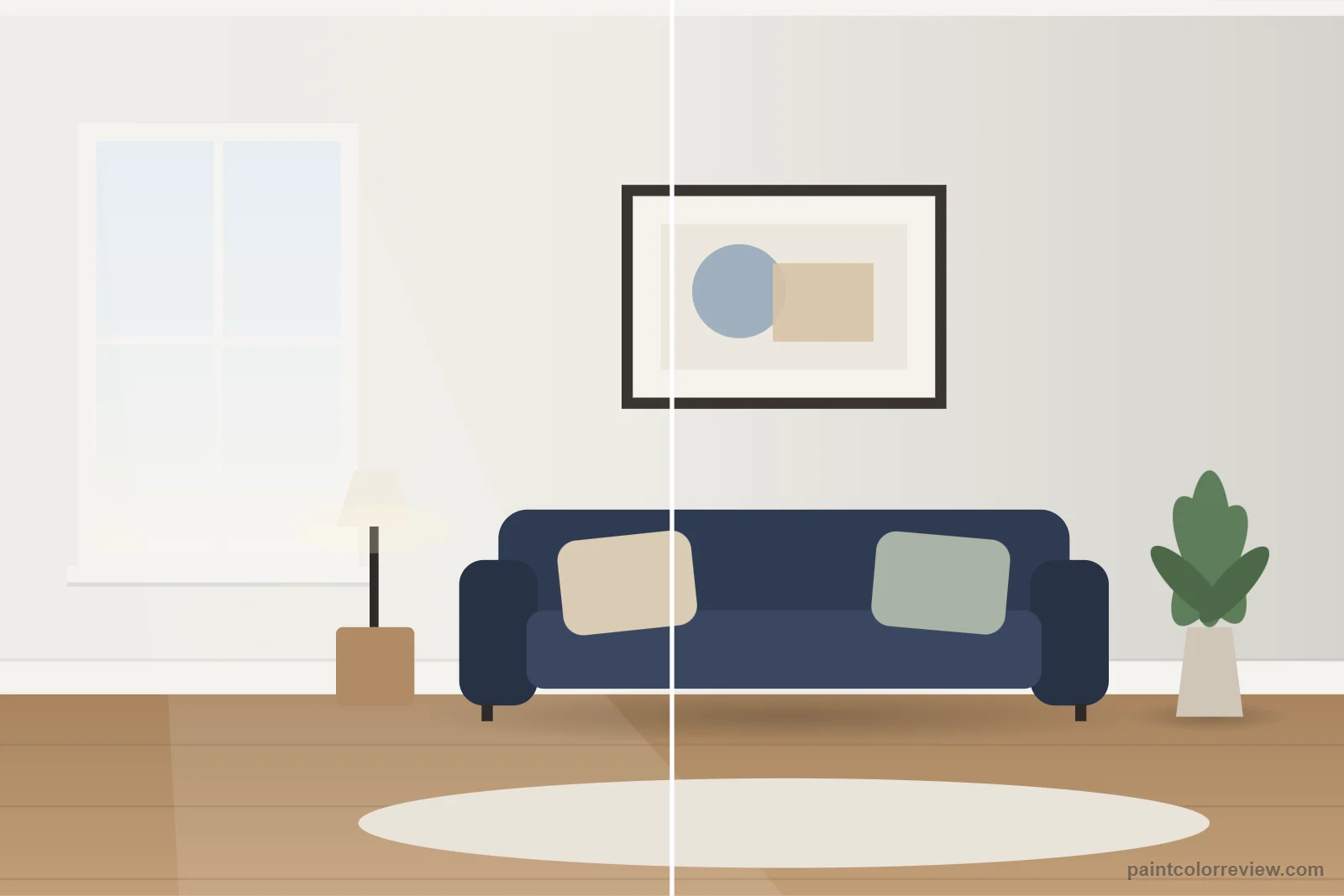
In north light both look clean; Snowbound can read very slightly gray. In warm light both soften equally.
Simulated from the manufacturer's color values. Always test samples in your own light.
Which one fits your room?
Choose Pure White if…
- You want the brighter, cleaner of the two
- You plan one white for walls, trim and ceilings
- Your room is on the dim side
Choose Snowbound if…
- You want a clean white with a softer feel
- Your walls are a cool gray and you want gentle trim
- You prefer a white with no green-gray lean
Room by room: where Pure White and Snowbound each work
Living rooms
Pure White and Snowbound are both soft whites that avoid the starkness of a gallery white. Pure White is a fraction brighter (LRV 84 against 82.8) and leans very slightly green-yellow; Snowbound sits closer to neutral, with a whisper of red. In a living room with warm wood and brass, Pure White blends more easily.
Bedrooms
Snowbound has a calm, slightly cooler feel in a north-facing bedroom. Pure White keeps a little more warmth there. In a sunny bedroom the two are hard to tell apart.
Kitchens and cabinets
Both are used for cabinets. Pure White looks better next to warm counters and creamy tile. Snowbound pairs well with white or gray quartz and cool marble, where its neutrality helps it look clean.
Bathrooms
With white tile and chrome fixtures, Snowbound reads as a crisp, quiet white. With beige or cream tile, Pure White relates better.
Exteriors
Sherwin-Williams rates both for exterior use. Both read as soft whites outdoors, and neither glares the way brighter whites can in full sun.
Trim and colors to pair with each
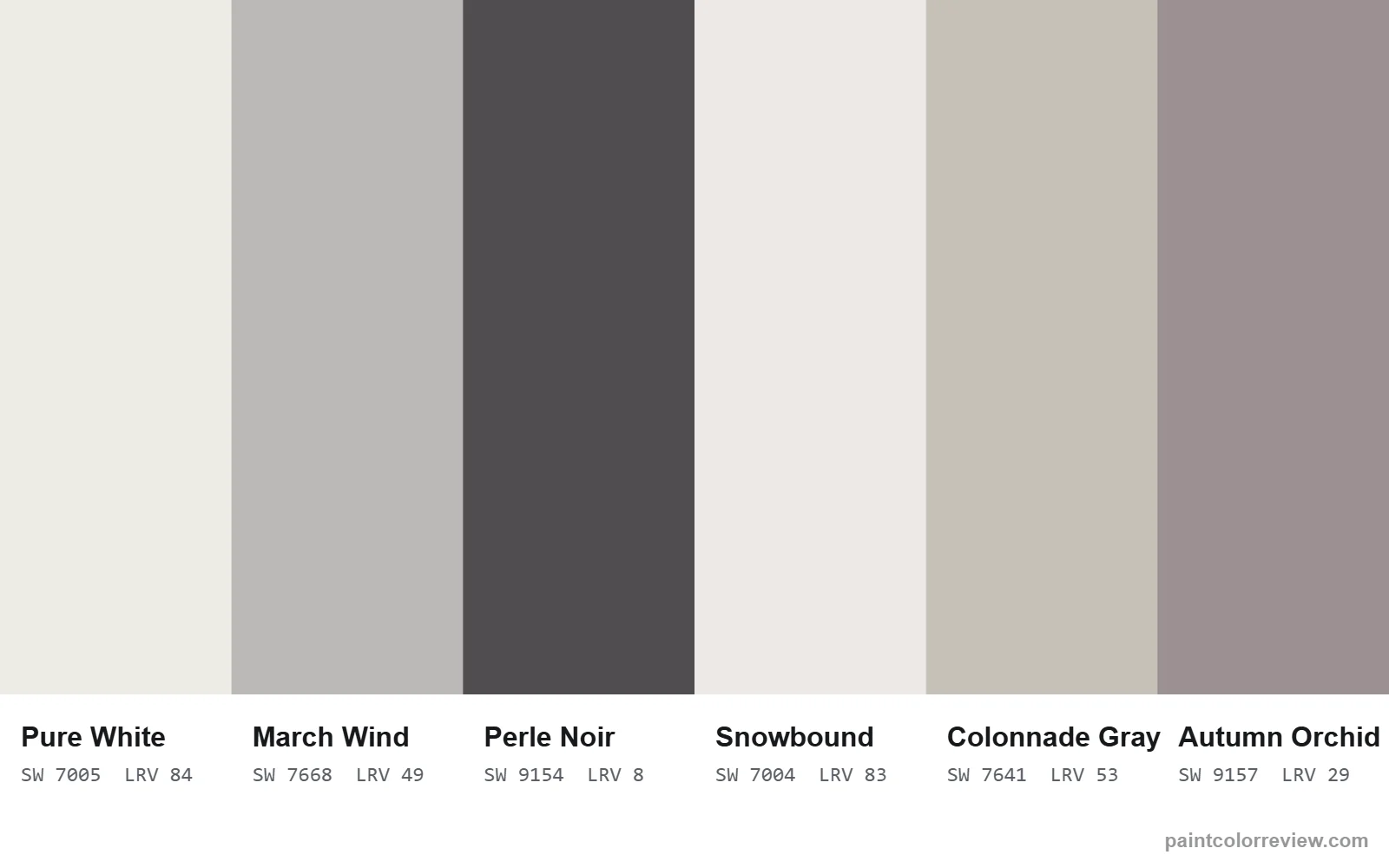
Sherwin-Williams lists Colonnade Gray (SW 7641) as a coordinating color for Snowbound, a warm mid-tone gray, and March Wind (SW 7668) for Pure White. For trim, either color works as its own trim in a tone-on-tone scheme, or use a brighter white for more contrast.
Coordinating colors listed by the manufacturers:
- Pure White: March Wind (SW 7668), LRV 48.7; Perle Noir (SW 9154), LRV 7.5
- Snowbound: Colonnade Gray (SW 7641), LRV 53.0; Autumn Orchid (SW 9157), LRV 29.4
Can you use Pure White and Snowbound in the same house?
Yes. Their measured difference is 1.3, so they work as walls and trim or in connecting rooms without looking mismatched. They are too close to use as an intentional contrast.
If neither is quite right
If you want a cleaner white than both, or one with more warmth, the table shows the nearest option in each direction, including choices from Benjamin Moore.
| Direction | Color | Brand | LRV | ΔE to Pure White | ΔE to Snowbound |
|---|---|---|---|---|---|
| Lighter | White Heron (OC-57) | Benjamin Moore | 86.7 | 1.5 | 2.7 |
| Darker | Cloud Cover (OC-25) | Benjamin Moore | 80.3 | 1.3 | 2.1 |
| Warmer | White Dove (OC-17) | Benjamin Moore | 83.2 | 1.4 | 2.5 |
| Cooler | Natural White (SW 9542) | Sherwin-Williams | 83.3 | 1.5 | 1.2 |
Read the full reviews
Pure White review · Snowbound review
Pure White vs Snowbound FAQs
Is Snowbound whiter than Pure White?
No. Pure White is slightly brighter (LRV 84.0 vs 82.8).
Is Snowbound warm or cool?
Close to neutral, with a very small warmth (yellow–blue +2.8).
Which is better for trim?
Either works; Pure White is a little crisper.
Does Snowbound have a pink undertone?
Only very faintly. Its green–red value is +0.1, essentially neutral, while Pure White leans slightly green (–0.7). Next to Pure White, Snowbound can look a touch warmer-pink.
Which is brighter?
Pure White, with an LRV of 84 against Snowbound's 82.8.
Which is better for cabinets?
Pure White with warm counters and wood; Snowbound with white or gray quartz and cool marble.