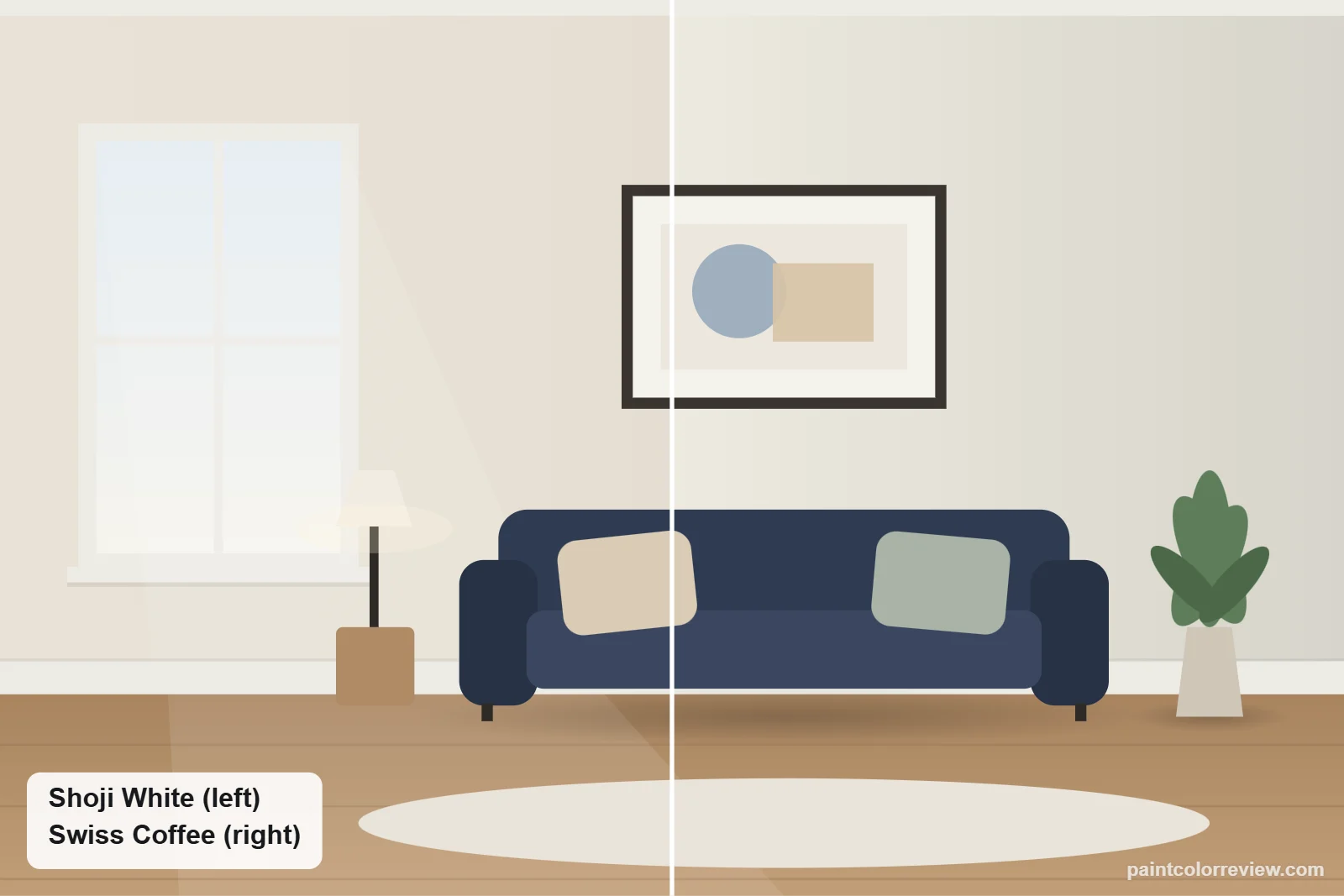
Shoji White (SW 7042) and Swiss Coffee (OC-45) both get called warm whites, but they do different jobs. Swiss Coffee is a true white with a creamy cast; Shoji White sits on the border between off-white and greige.
Side-by-side numbers
| Shoji White | Swiss Coffee | |
|---|---|---|
| Brand | Sherwin-Williams | Benjamin Moore |
| Code | SW 7042 | OC-45 |
| Hex | #E6DFD3 | #EEECE1 |
| RGB | 230, 223, 211 | 238, 236, 225 |
| LRV | 74.3 | 81.9 (lighter) |
| Yellow–blue (b*) | +6.7 (warmer) | +5.6 |
| Green–red (a*) | +0.3 | −1.2 |
| Difference (ΔE) | 3.5 |
Hex, RGB and LRV from the manufacturers' color records. CIELAB values and ΔE (CIEDE2000) calculated from those hex values.
Swiss Coffee reflects about 82% of light and Shoji White about 74% (see our LRV guide for what that means). The measured difference is 3.6, so on a wall they look like clearly different colors, not two versions of one white.
Undertones: Shoji White vs Swiss Coffee
Shoji White is the warmer and more beige of the two: its green–red value is +0.3 against Swiss Coffee’s −1.2, and its yellow–blue +6.7 against +5.6. Combined with its lower LRV, that gives Shoji White a soft, earthy, slightly gray-beige look. Swiss Coffee has a faint green note and reads cleaner and creamier.
How they compare in each light
North light is where they split most. Swiss Coffee stays a soft white; Shoji White can turn gray-beige and, in small rooms, a little dingy. In south and west sun Shoji White comes alive as a warm, glowing off-white, while Swiss Coffee turns creamy. Under warm bulbs both look cozy; Shoji White looks deeper.
Simulated from the manufacturer's color values. Always test samples in your own light.
Which one fits your room?
Choose Shoji White if…
- Your room is bright and you want a soft greige-white rather than white
- You want walls that feel calm and earthy, with brighter trim
- You are pairing with natural wood, linen and stone
Choose Swiss Coffee if…
- You want a true white with creamy warmth
- The room is small, dim or north-facing
- You are painting kitchen cabinets or want walls and trim in one color
Should you choose Shoji White or Swiss Coffee for living room walls?
Choose by light. In a bright living room with large south- or west-facing windows, Shoji White gives soft, warm walls that do not glare. In a living room with modest light, or one that faces north, Swiss Coffee keeps the room bright and avoids the gray-beige cast Shoji White takes on in shade.
Where each one works
Kitchens and cabinets
Swiss Coffee is the stronger cabinet color: it looks clean and white on doors, while Shoji White can look heavy or a little dated on a full kitchen. Shoji White works better on walls behind white cabinets.
Bedrooms
Both make restful bedrooms. Shoji White feels cocooning in a sunny bedroom; Swiss Coffee is the safer pick in a bedroom with one small window.
Bathrooms
In a small or windowless bath, use Swiss Coffee; its higher LRV keeps the room bright under vanity lights. Shoji White suits larger, naturally lit baths with warm stone or wood.
Exteriors
Shoji White reflects less light, so it glares less on a sunny facade and reads as a warm, soft off-white. Swiss Coffee gives a brighter, more classic white house, best with brighter white trim.
Can you use Shoji White and Swiss Coffee together?
Yes, as walls and trim. Shoji White walls with Swiss Coffee trim and doors is a soft, warm two-tone scheme, because the 3.6 gap is clearly deliberate. The reverse does not work: trim darker than the walls looks dingy.
Trim and colors to pair with each
With Shoji White walls, Pure White or Swiss Coffee make clean, warm trims; very bright whites such as Extra White can make Shoji White look grayer. With Swiss Coffee, White Dove or Chantilly Lace work as trim, or use Swiss Coffee itself for a tonal look.
If neither is quite right
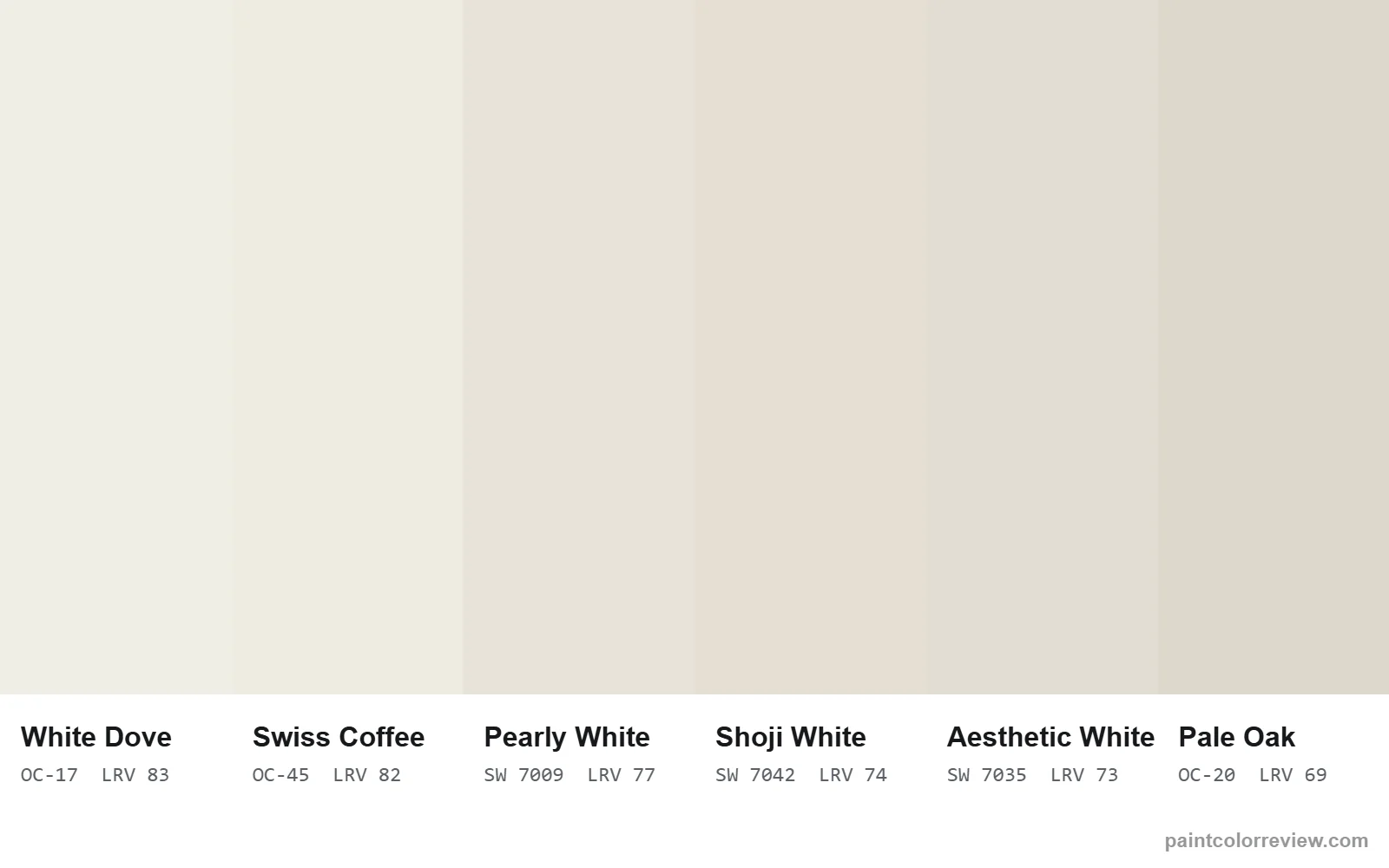
For something between them, Pearly White (LRV 77.3) is brighter than Shoji White but softer than Swiss Coffee. For a Benjamin Moore greige-white like Shoji White, Pale Oak (LRV 68.6) is a little darker and grayer. For Swiss Coffee’s Sherwin-Williams near-twin, see Alabaster vs Swiss Coffee, and for Shoji White against Alabaster, Alabaster vs Shoji White.
Read the full reviews
Shoji White review · Swiss Coffee review · Swiss Coffee vs White Dove
Shoji White vs Swiss Coffee FAQs
Should I choose Shoji White or Swiss Coffee for my living room walls?
Shoji White for a bright, sunny living room where you want a soft greige-white; Swiss Coffee for a room with modest or north light, where Shoji White can look gray.
Is Shoji White darker than Swiss Coffee?
Yes. Shoji White has an LRV of 74.3 against Swiss Coffee’s 81.91, so it reflects noticeably less light.
Which is warmer, Shoji White or Swiss Coffee?
Shoji White. It has more beige (green–red +0.3 vs −1.2) and more yellow (+6.7 vs +5.6). Swiss Coffee is the cleaner, creamier white.
Does Shoji White look dingy?
It can in small, north-facing or dim rooms, where its lower LRV and beige undertone read gray-beige. In good light it looks warm and soft.
Which is better for kitchen cabinets?
Swiss Coffee. It reads as a clean warm white on doors; Shoji White can look heavy on a full kitchen.
What trim color looks best with Shoji White?
Pure White or Swiss Coffee. Very bright, cool whites can make Shoji White look grayer.
Can I use Shoji White walls with Swiss Coffee trim?
Yes. The 3.6 difference reads as a deliberate two-tone scheme. Avoid the reverse, where darker trim looks dingy.
What is the Benjamin Moore equivalent of Shoji White?
No Benjamin Moore color is an exact match. Fog Mist (OC-31) is the closest in our data, 1.4 apart, followed by Fossil (AF-65) at 1.7. Pale Oak (2.1 apart) is a little darker and grayer.