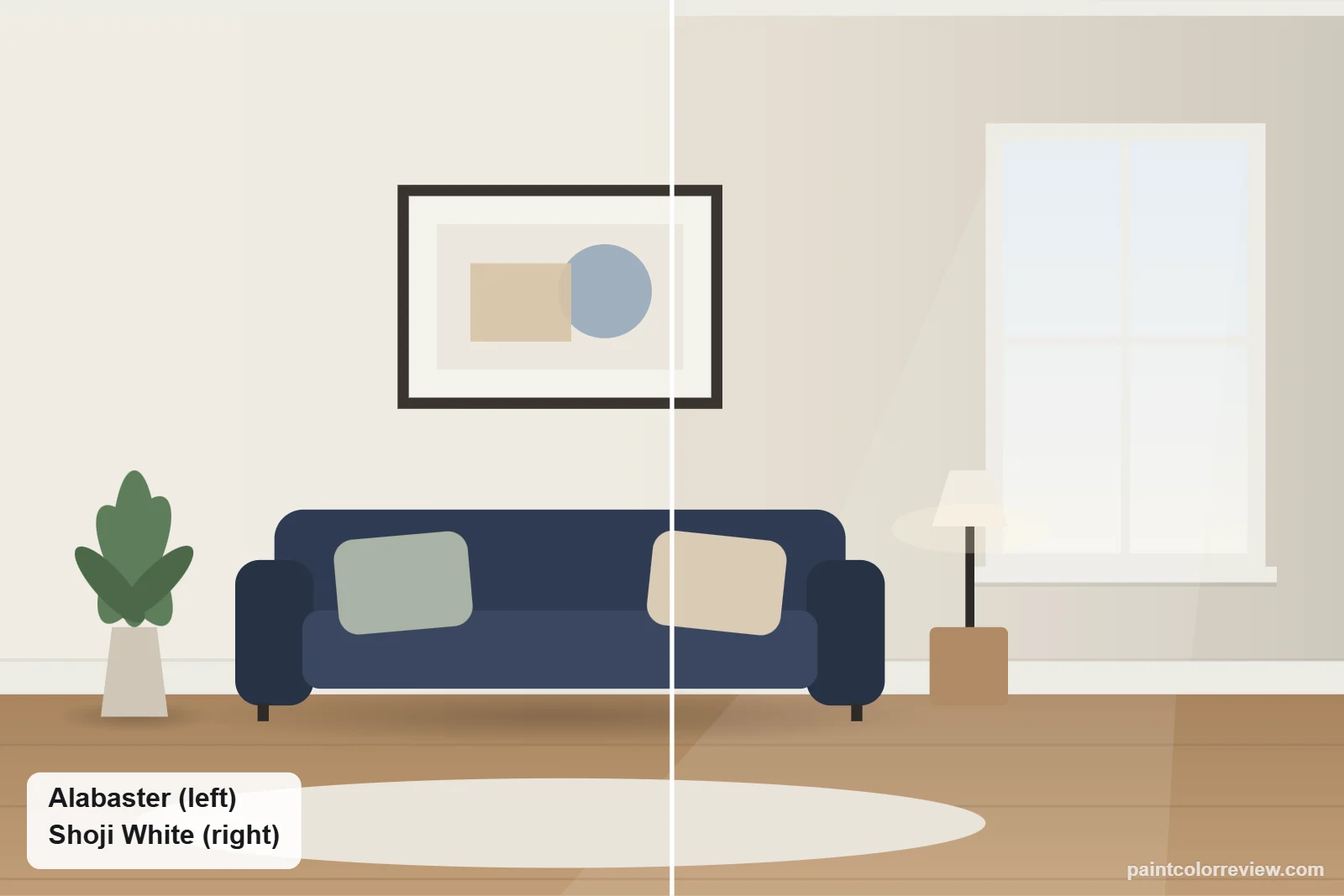
Alabaster (SW 7008) and Shoji White (SW 7042) are both soft, warm Sherwin-Williams whites, but Shoji White is a step deeper: an off-white that borders on greige.
Side-by-side numbers
| Alabaster | Shoji White | |
|---|---|---|
| Brand | Sherwin-Williams | Sherwin-Williams |
| Code | SW 7008 | SW 7042 |
| Hex | #EDEAE0 | #E6DFD3 |
| RGB | 237, 234, 224 | 230, 223, 211 |
| LRV | 82.2 (lighter) | 74.3 |
| Yellow–blue (b*) | +5.2 | +6.7 (warmer) |
| Green–red (a*) | −0.7 | +0.3 |
| Difference (ΔE) | 3.0 |
Hex, RGB and LRV from the manufacturers' color records. CIELAB values and ΔE (CIEDE2000) calculated from those hex values.
The big difference is brightness: Alabaster has an LRV of 82.2, Shoji White 74.3. With a ΔE of 3.0, the two look clearly different on walls.
Undertones: Alabaster vs Shoji White
Shoji White is warmer and more beige (yellow–blue +6.7 vs +5.2) and neutral on the green–red axis (+0.3). Alabaster is the cleaner, whiter of the two.
How they compare in each light
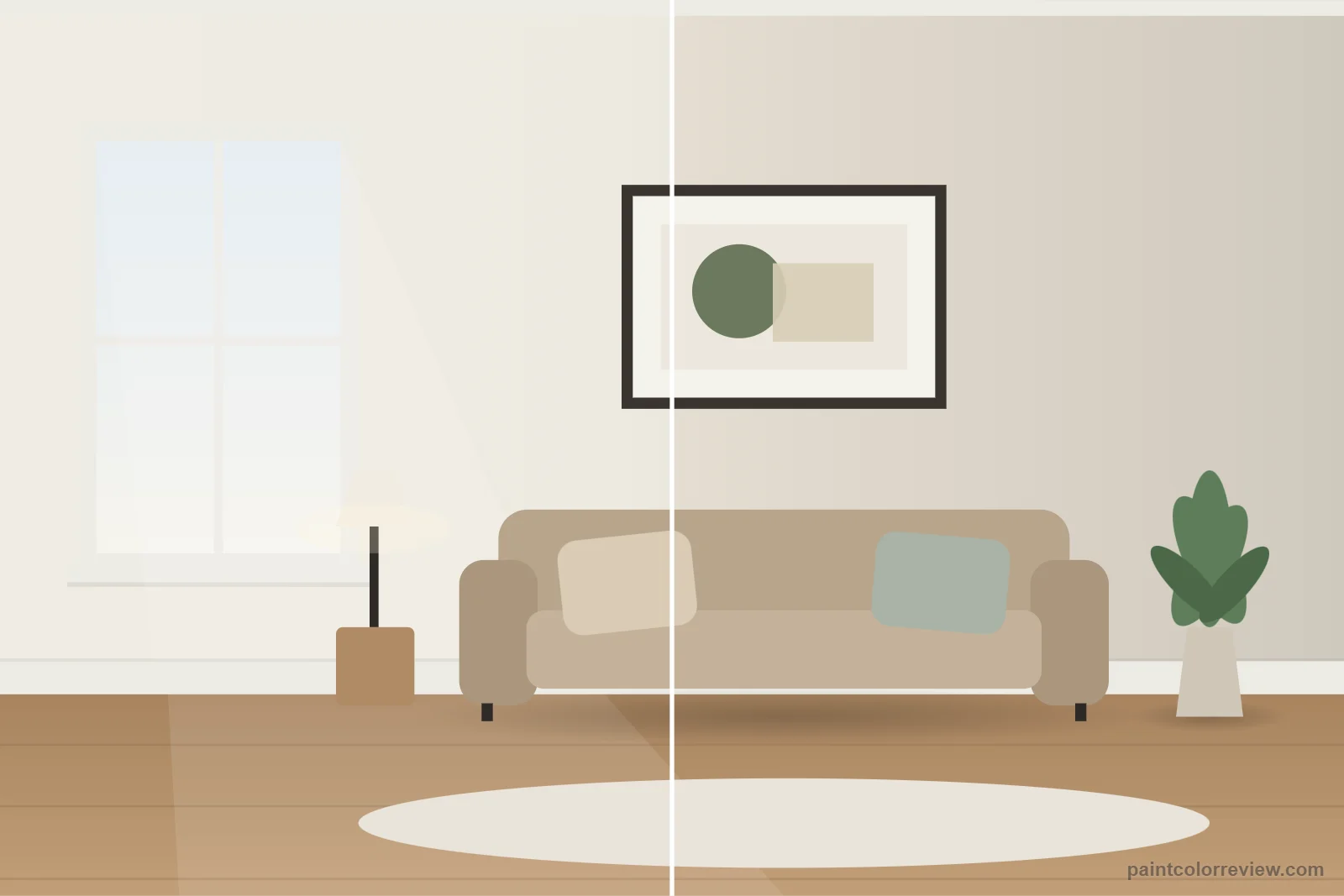
In very bright, south-facing rooms Shoji White's depth stops white walls from glaring. In dim north rooms it can look beige-gray, where Alabaster stays white.
Simulated from the manufacturer's color values. Always test samples in your own light.
Which one fits your room?
Choose Alabaster if…
- You want walls that read clearly white
- The room is dim or north-facing
- You want one white for walls, trim and cabinets
Choose Shoji White if…
- You want a soft off-white with gentle color
- The room is very bright and white glares
- You love warm, greige-leaning neutrals
Room by room: where Alabaster and Shoji White each work
Living rooms
Shoji White gives a living room a soft, colored wall rather than a white one, which suits large, bright rooms where a true white would glare. Alabaster is the better choice for an average or dim living room: it is 7.9 LRV points brighter and still reads as white.
Bedrooms
Shoji White makes a calm, cocooning bedroom in good daylight. In a north-facing bedroom it can look beige-gray, and Alabaster keeps the room lighter.
Kitchens and cabinets
Alabaster is the more common cabinet color because it reads as white. Shoji White on cabinets reads as an off-white or very light greige, which works well with warm wood floors and creamy counters but can look dingy next to bright white quartz.
Bathrooms
In a small, windowless bathroom, Shoji White's lower LRV makes the room feel darker. Alabaster is the safer choice unless the bathroom has a window.
Exteriors
Both are rated for exterior use. Bright sun pushes Shoji White toward a soft white, so it is a good pick if lighter whites look too stark on your house. Alabaster will look brighter and whiter outdoors.
Trim and colors to pair with each
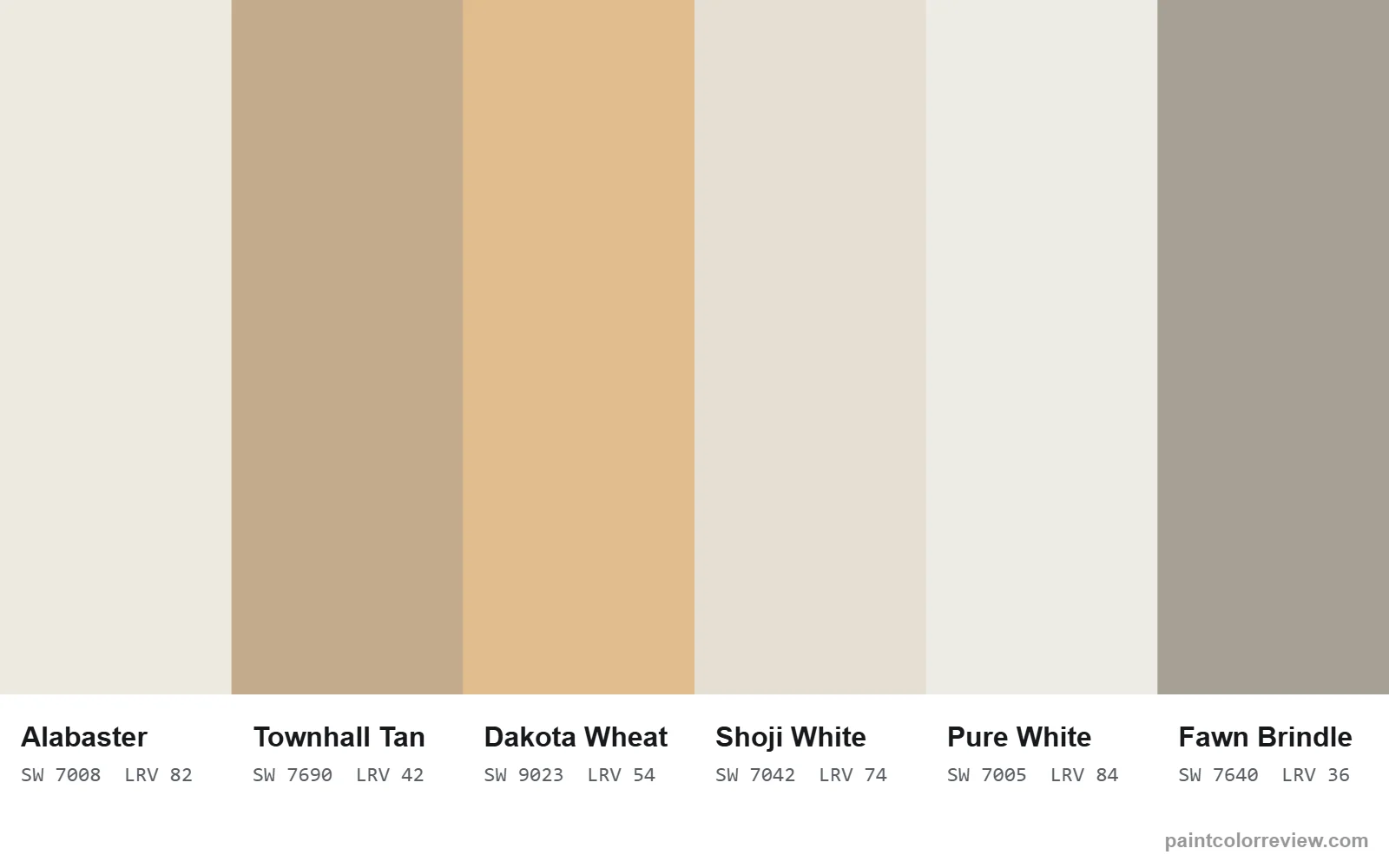
Sherwin-Williams lists Pure White (SW 7005) as a coordinating color for Shoji White, and it makes a clean trim for it. Alabaster also works as trim against Shoji White walls, giving a softer contrast. Accent options from the brand's own lists are Fawn Brindle (SW 7640) and Perle Noir (SW 9154) for Shoji White, and Townhall Tan (SW 7690) for Alabaster.
Coordinating colors listed by the manufacturers:
- Alabaster: Townhall Tan (SW 7690), LRV 42.3; Dakota Wheat (SW 9023), LRV 54.2
- Shoji White: Pure White (SW 7005), LRV 84.0; Fawn Brindle (SW 7640), LRV 35.5; Perle Noir (SW 9154), LRV 7.5
Can you use Alabaster and Shoji White in the same house?
Yes, and it is one of the better pairings on this site: Shoji White walls with Alabaster trim. A difference of 3.0 is clearly visible, so the two read as wall and trim rather than as a near-match.
If neither is quite right
If Shoji White is too dark and Alabaster too bright, look between them on LRV; if you want more warmth or a cleaner look, use the table to find the nearest option in each direction.
| Direction | Color | Brand | LRV | ΔE to Alabaster | ΔE to Shoji White |
|---|---|---|---|---|---|
| Lighter | Westhighland White (SW 7566) | Sherwin-Williams | 85.8 | 1.3 | 3.3 |
| Darker | White Sesame (SW 9586) | Sherwin-Williams | 71.3 | 4.0 | 1.2 |
| Warmer | Fossil (AF-65) | Benjamin Moore | 71.6 | 3.6 | 1.6 |
| Cooler | Cloud Cover (OC-25) | Benjamin Moore | 80.3 | 1.2 | 3.5 |
Read the full reviews
Alabaster review · Shoji White review
Alabaster vs Shoji White FAQs
Is Shoji White darker than Alabaster?
Yes, noticeably: LRV 74.3 against 82.2.
Is Shoji White warmer than Alabaster?
Yes (yellow–blue +6.7 vs +5.2), so it reads more beige.
Can I use Alabaster trim with Shoji White walls?
Yes. Alabaster is brighter and cleaner, so it reads as soft, warm trim against Shoji White.
Can you use Alabaster trim with Shoji White walls?
Yes. Alabaster is lighter and slightly cleaner, so it reads as a soft trim against Shoji White without the starkness of a bright white.
Is Shoji White a greige?
It sits on the border. With an LRV of 74.3 and a warm, neutral undertone, it reads as an off-white in bright rooms and a light greige in dim ones.
Which is better in a dark room?
Alabaster. Its LRV of 82.2 reflects noticeably more light than Shoji White's 74.3.