What is LRV in paint? Light reflectance value explained
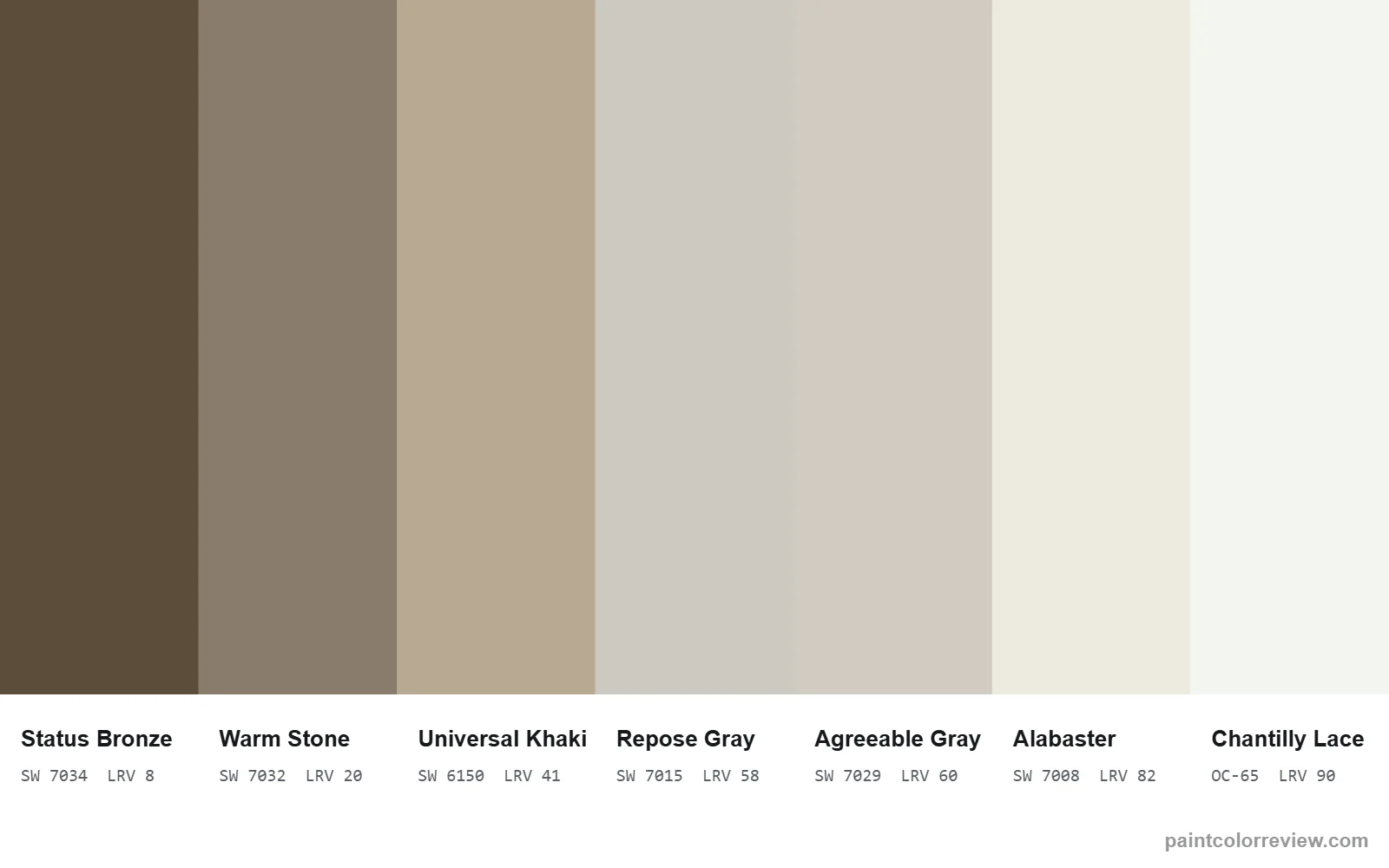
LRV (light reflectance value) measures how much light a paint color reflects, on a scale from 0 (black) to 100 (pure white). The higher the number, the lighter and brighter the color looks on the wall. Most brands print it on the back of the color chip or on the color's web page.
What does LRV mean?
LRV stands for light reflectance value. It is a number from 0 to 100 that tells you how much visible light a paint color reflects. 0 is a theoretical perfect black that absorbs all light; 100 is a theoretical perfect white that reflects all of it. Real paints sit in between: the brightest whites reach about 90, and the deepest blacks sit in the low single digits.
In everyday terms, LRV tells you how light or dark a color will look on the wall, independent of its hue. A gray and a beige with the same LRV will look about equally light, even though one is cooler and one warmer.
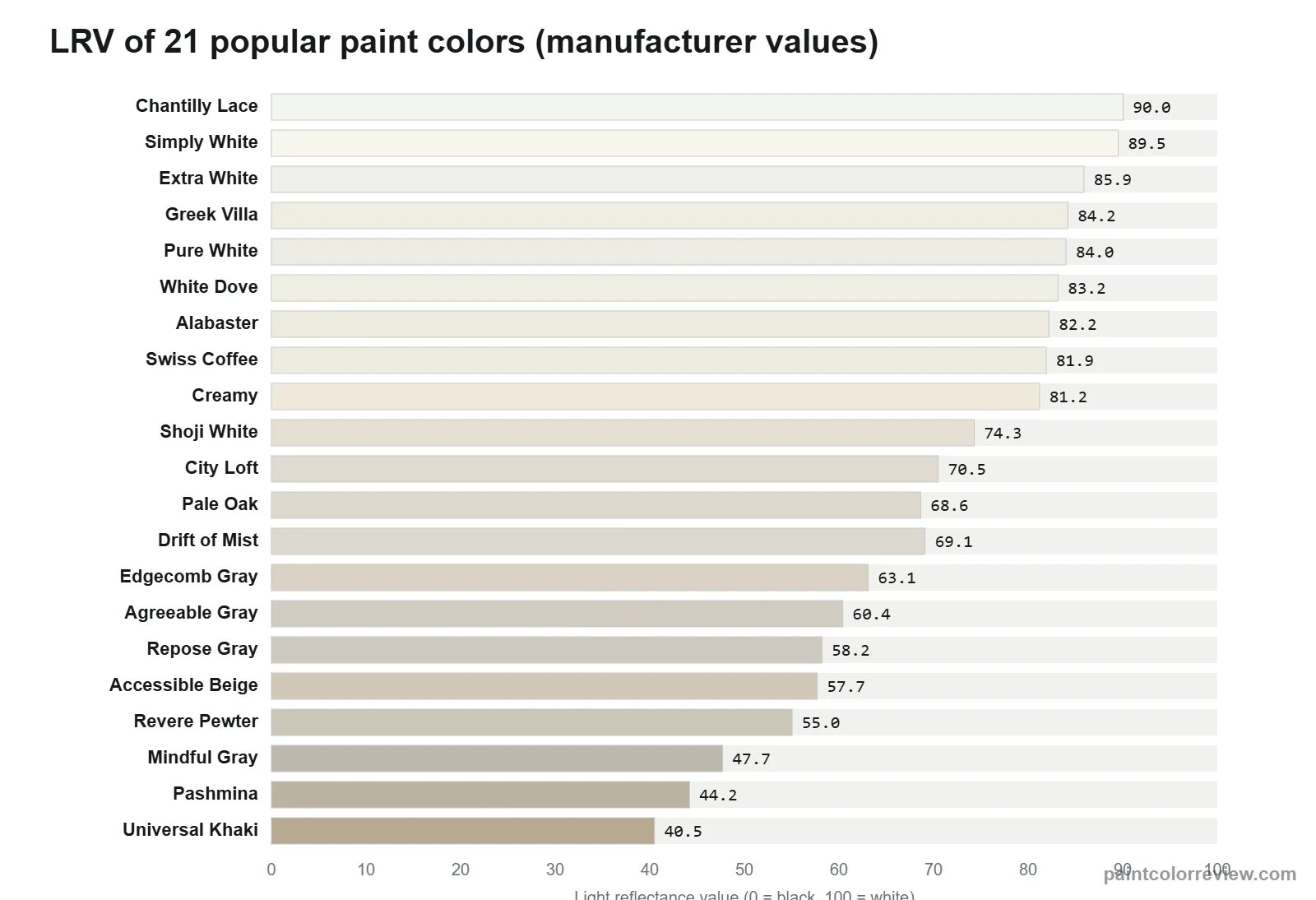
Where popular colors sit on the LRV scale
These are the manufacturers' own LRVs. Notice how close Repose Gray (58.2) and Agreeable Gray (60.4) are: on a wall they look about equally light, so the choice between them comes down to undertone.
What the LRV ranges mean
| LRV | How it reads | Typical use | Example |
|---|---|---|---|
| 85–100 | Bright white | Ceilings, trim, crisp walls | Chantilly Lace (90.0) |
| 70–85 | Off-white, light | Whole-house walls, cabinets | Alabaster (82.2) |
| 50–70 | Mid-light | Living rooms, bedrooms, open plans | Agreeable Gray (60.4) |
| 20–50 | Mid-tone | Accent walls, cabinets, well-lit rooms | Universal Khaki (40.5) |
| 0–20 | Dark | Doors, islands, moody rooms | Status Bronze (8.0) |
How LRV affects a room
Brightness. A higher LRV bounces more light around the room, which makes a space feel brighter and, often, larger. This matters most in rooms with little daylight.
Contrast. The gap between two LRVs controls how much they stand out from each other. A white trim (LRV 85+) against a mid greige (LRV 60) gives clear definition; two whites a few points apart give a soft, tonal look. Accessibility guidance often recommends a large LRV difference between walls, doors and floors so they are easier to tell apart for people with low vision.
Heat outdoors. On exteriors, lower-LRV colors absorb more sunlight, so dark siding and doors get hotter than light ones.
How to use LRV when choosing paint
- Match LRV to the light the room gets. A dim, north-facing room usually needs a higher LRV (60 and up) to avoid looking gloomy; a bright south-facing room can take a deeper color.
- Compare colors at the same LRV. Once two colors share an LRV, you are choosing on undertone alone.
- Plan contrast for trim and doors. A bigger LRV gap between wall and trim makes the trim stand out more.
- Still test a sample. LRV tells you how light a color is, not whether it leans warm, cool, green or pink.
Where to find a color's LRV
Paint makers print LRV on the back of the color chip or on the color's page on their website. Every review on this site lists it in the color data card, along with a ruler showing where it sits from 0 to 100. Browse the white paint colors or greige paint colors pages to compare LRVs side by side.
How LRV is measured
Paint makers measure LRV with a spectrophotometer. It is the color's luminance (the Y value in the CIE color system) on a 0–100 scale, where 100 would be a perfect white reflector. Because luminance can also be calculated from a color's RGB value, you can estimate LRV from a hex code. We checked: for the 22 Sherwin-Williams colors we have reviewed, the estimate lands within 0.4 of the published LRV every time. For the 12 Benjamin Moore colors the gap is larger, up to 2.5, because the on-screen color the brand shows is only an approximation of the paint. Use the published LRV when it is available.
Same LRV, different look
LRV only describes lightness. Two colors with almost the same LRV can look completely different on the wall because of their undertone. These pairs from our reviews are within about one LRV point of each other:
| Color A | Color B | LRV | How they differ |
|---|---|---|---|
| Repose Gray (SW 7015) | Accessible Beige (SW 7036) | 58.2 / 57.7 | warmth +4.8 vs +8.7; green–red -0.6 vs +0.9 |
| Balboa Mist (OC-27) | Natural Linen (SW 9109) | 65.5 / 66.3 | warmth +5.4 vs +9.4; green–red -0.4 vs +1.5 |
| Edgecomb Gray (HC-173) | Sea Salt (SW 6204) | 63.1 / 63.2 | warmth +8.1 vs +3.4; green–red -0.5 vs -3.2 |
| Snowbound (SW 7004) | Dover White (SW 6385) | 82.8 / 82.5 | warmth +2.8 vs +7.5; green–red +0.1 vs -0.3 |
Repose Gray and Accessible Beige are equally light, but one reads as a cool gray and the other as a warm beige. Edgecomb Gray and Sea Salt share an LRV, yet Sea Salt is clearly green. Once two colors have the same LRV, you are choosing on undertone alone; see the undertones guide.
LRV guidelines by surface
These are rules of thumb, not fixed rules; your light and finishes always come first.
| Surface | Typical LRV | Why |
|---|---|---|
| Ceilings | 80 and up | Ceilings sit in shadow; a high LRV keeps them from looking gray. |
| Trim and doors | About 82–92 | A clear gap above the wall color gives a crisp line. |
| Whole-house walls | About 55–75 | Light enough to stay bright, deep enough to read as a color. |
| Dim or north-facing rooms | 60 and up | Lower values can look gloomy without daylight. |
| Islands, lower cabinets, accent walls | Below about 50 | Deeper colors add contrast and hide wear. |
| Exterior body | Depends on sun | Strong sun makes colors look lighter and very bright whites can glare; dark colors absorb more heat. |
LRV of every color we have reviewed
Manufacturer LRVs for every color on this site, from lightest to darkest. Each name links to its full review.
| Color | Brand | LRV |
|---|---|---|
| Chantilly Lace (OC-65) | Benjamin Moore | 90.0 |
| Simply White (OC-117) | Benjamin Moore | 89.5 |
| Extra White (SW 7006) | Sherwin-Williams | 85.9 |
| Cloud White (OC-130) | Benjamin Moore | 85.0 |
| Greek Villa (SW 7551) | Sherwin-Williams | 84.2 |
| Pure White (SW 7005) | Sherwin-Williams | 84.0 |
| White Dove (OC-17) | Benjamin Moore | 83.2 |
| Snowbound (SW 7004) | Sherwin-Williams | 82.8 |
| Dover White (SW 6385) | Sherwin-Williams | 82.5 |
| Alabaster (SW 7008) | Sherwin-Williams | 82.2 |
| Swiss Coffee (OC-45) | Benjamin Moore | 81.9 |
| Creamy (SW 7012) | Sherwin-Williams | 81.2 |
| Pearly White (SW 7009) | Sherwin-Williams | 77.3 |
| Shoji White (SW 7042) | Sherwin-Williams | 74.3 |
| Aesthetic White (SW 7035) | Sherwin-Williams | 73.1 |
| Antique White (SW 6119) | Sherwin-Williams | 72.5 |
| City Loft (SW 7631) | Sherwin-Williams | 70.5 |
| Egret White (SW 7570) | Sherwin-Williams | 69.6 |
| Drift of Mist (SW 9166) | Sherwin-Williams | 69.1 |
| Pale Oak (OC-20) | Benjamin Moore | 68.6 |
| Natural Linen (SW 9109) | Sherwin-Williams | 66.3 |
| Balboa Mist (OC-27) | Benjamin Moore | 65.5 |
| Natural Cream (OC-14) | Benjamin Moore | 64.8 |
| Gray Owl (OC-52) | Benjamin Moore | 64.5 |
| Sea Salt (SW 6204) | Sherwin-Williams | 63.2 |
| Edgecomb Gray (HC-173) | Benjamin Moore | 63.1 |
| Gossamer Veil (SW 9165) | Sherwin-Williams | 61.8 |
| Agreeable Gray (SW 7029) | Sherwin-Williams | 60.4 |
| Repose Gray (SW 7015) | Sherwin-Williams | 58.2 |
| Accessible Beige (SW 7036) | Sherwin-Williams | 57.7 |
| Revere Pewter (HC-172) | Benjamin Moore | 55.0 |
| Mindful Gray (SW 7016) | Sherwin-Williams | 47.7 |
| Pashmina (AF-100) | Benjamin Moore | 44.2 |
| Universal Khaki (SW 6150) | Sherwin-Williams | 40.5 |
FAQs
What is a good LRV for a living room?
Most living rooms suit an LRV between about 50 and 70: light enough to keep the room bright, with enough depth that the walls don't look washed out. If the room faces north or has few windows, go toward 70 or higher.
Does a higher LRV make a room look bigger?
Usually, yes. Higher-LRV walls reflect more light, which softens shadows in corners and makes a space feel more open.
What LRV is considered white?
Most paints called white have an LRV above about 80; the brightest reach around 90.
What is the LRV of black paint?
Very dark paints usually sit in the low single digits, between about 2 and 6.
Is LRV the same as how bright a color looks?
Closely related. LRV measures reflected light, which is the main thing that makes a color look light or dark; undertone and surroundings then change how it reads.
What is a good LRV for exterior paint?
There is no single number. In strong sun, colors look lighter than on the chip and very bright whites can glare, so many people choose a soft white in the high 70s or low 80s rather than the brightest white. Darker colors absorb more heat.
Can you calculate LRV from a hex code?
You can estimate it, because LRV is a luminance value and luminance can be calculated from RGB. For Sherwin-Williams colors our estimates were within 0.4 of the published LRV; for Benjamin Moore they were up to 2.5 off, so use the published figure when you can.
What is the LRV of White Dove?
Benjamin Moore lists White Dove (OC-17) at an LRV of 83.16.
What LRV is best for a north-facing room?
Usually 60 or higher, with a warm undertone. North light is cool and indirect, so deeper colors can look dull.