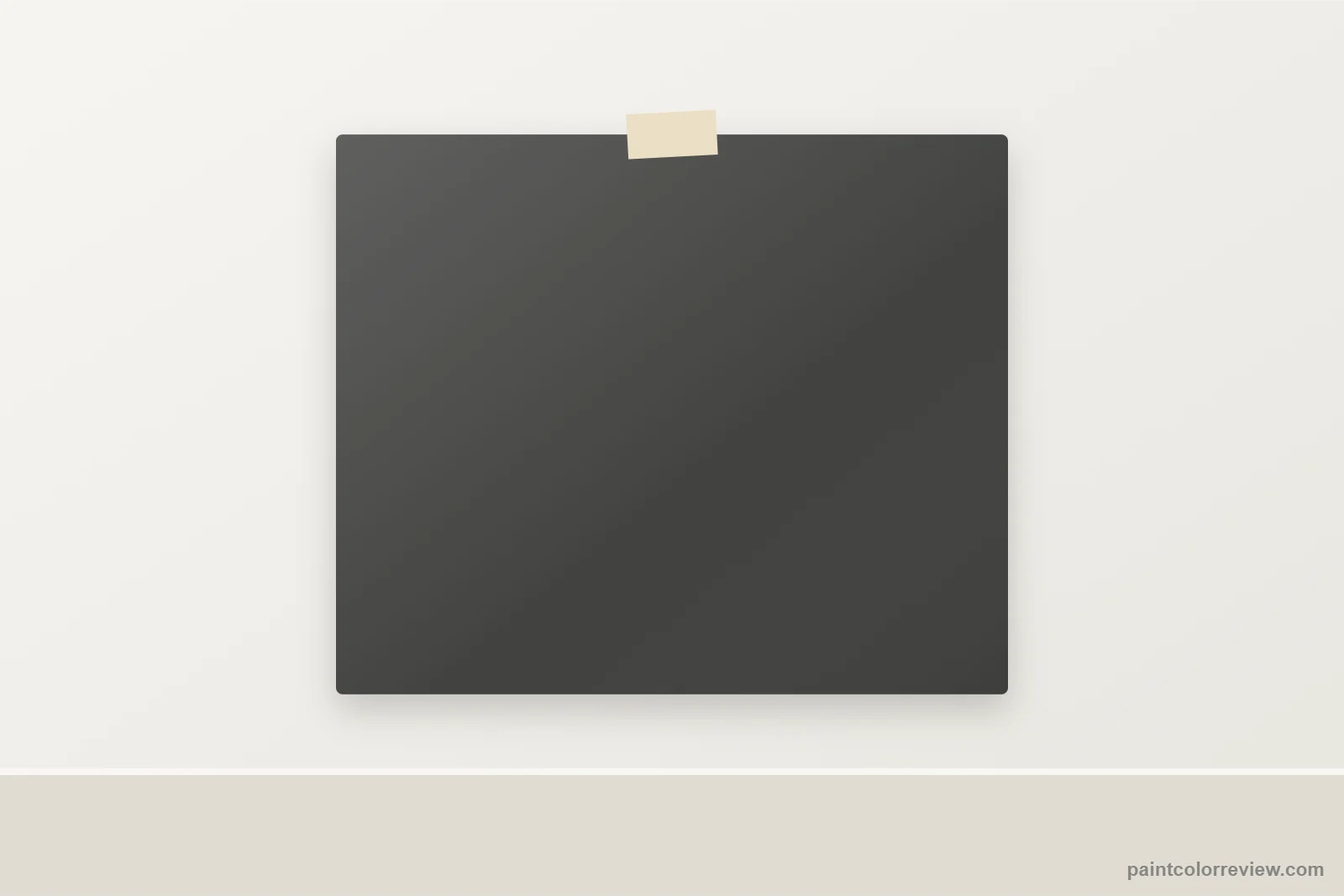
What color is Iron Ore?
Iron Ore (SW 7069) is a deep charcoal that most people see as a soft black. With an LRV of 5.5 it reflects very little light, yet it is noticeably gentler than a true black such as Tricorn Black (LRV 2.8), which sits at the top of the same Sherwin-Williams strip. Sherwin-Williams describes it as a cool, deep charcoal that works best used sparingly in well-lit rooms or on exteriors.
Is Iron Ore black or gray?
Technically a very dark gray, visually a soft black. Its LRV of 5.5 is about twice that of Tricorn Black, so on a sunny wall you can see that it is charcoal. Indoors, on doors, cabinets or in a dim room, most people read it as black.
Iron Ore undertones
Measured, Iron Ore is almost perfectly neutral: a green–red value of −0.4 and a yellow–blue value of +1.2. That is far less warmth than brown-leaning darks such as Urbane Bronze (+4.1) or Black Fox (+4.7), so Iron Ore reads as charcoal rather than espresso. Next to warm wood it looks slightly cool; next to navy or blue-gray it looks slightly warm.
Iron Ore LRV and light
At LRV 5.5 Iron Ore absorbs most of the light that hits it. In north light and at dusk it reads as black; in strong sun it opens up to a visible charcoal, which is why it looks softer on a house than on a paint chip.
Near black, slightly cool
Soft, visible charcoal
Charcoal in the morning, near black later
Near black by day, softer charcoal at sunset
Simulated from the manufacturer's color values. Always test a sample in your own light.
Best uses for Iron Ore
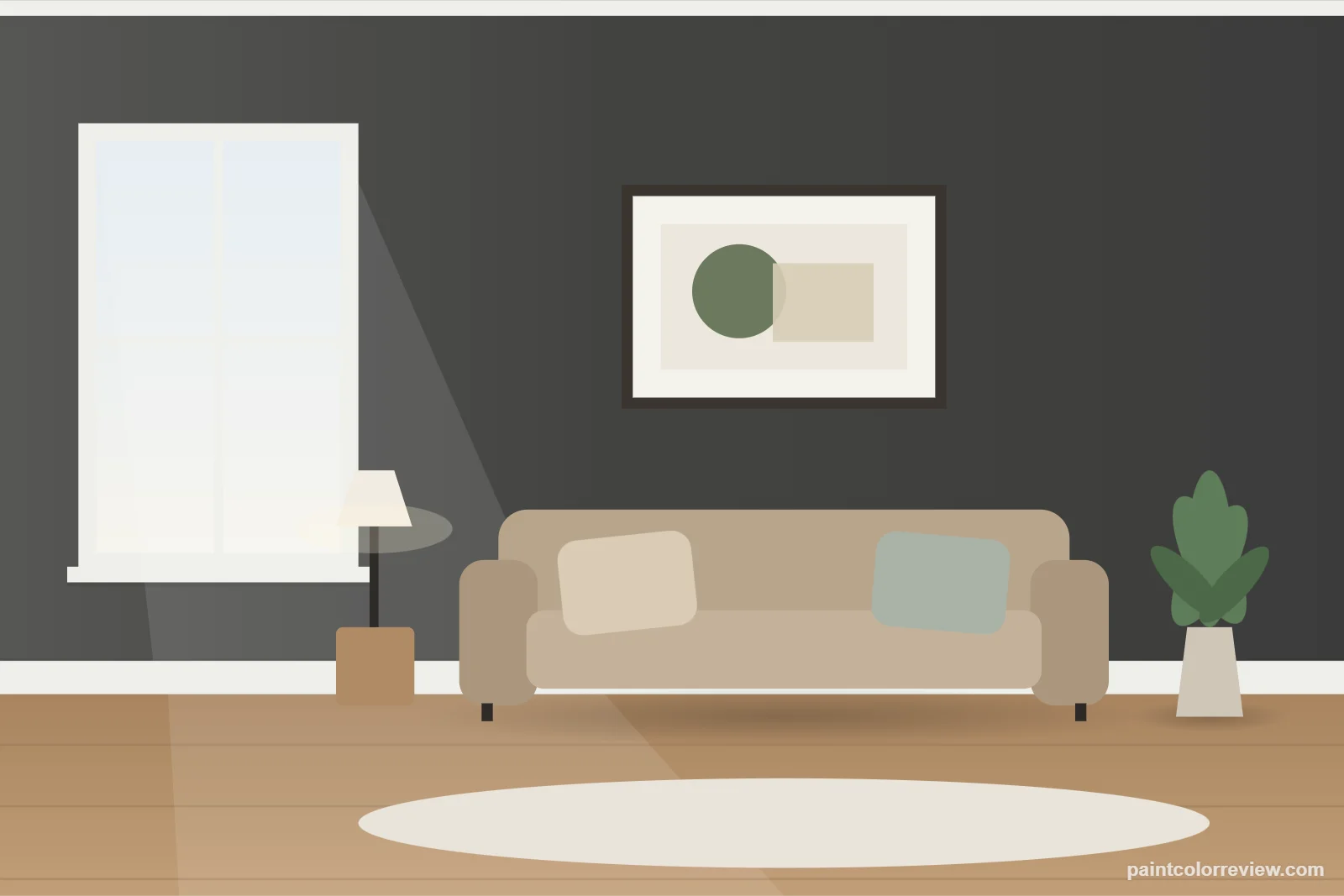
Exteriors
Iron Ore is one of the most used dark exterior colors because sunlight lifts it to a rich charcoal instead of a flat black. It suits modern farmhouse, contemporary and craftsman homes with wood, stone or white accents. Dark siding absorbs more heat than light siding, so if your home has vinyl, check the siding maker's guidance on dark colors first.
Front doors and garage doors
A charcoal-black door gives strong contrast against white, greige or brick without the harshness of pure black, and it hides dirt well. Use a durable exterior enamel in a satin or semi-gloss finish.
Kitchen cabinets and islands
On an island or lower cabinets with white uppers, Iron Ore grounds the room. Brass and brushed nickel stand out against it; matte black hardware mostly disappears.
Accent walls, offices and powder rooms
In a well-lit room it makes a dramatic feature wall or a moody office. In a small powder room, painting walls, ceiling and trim all in Iron Ore creates a cocooning, deliberate look.
Interior doors and window trim
Charcoal interior doors and window frames are a popular way to add contrast in white rooms. Higher sheens show dust and fingerprints more on dark colors, so a satin finish is the practical middle ground.
When to avoid Iron Ore
Skip Iron Ore on the walls of small, dim rooms unless you want them to feel enclosed; at LRV 5.5 it needs good light to read as anything but black. If you want a true black, Tricorn Black (SW 6258) is darker and more neutral. If your palette is warm wood, cream and brass, a warmer dark such as Urbane Bronze sits more comfortably.
Iron Ore pros and cons
Pros
- Near-neutral, so it works with cool and warm palettes alike.
- Softer than true black on exteriors, where sun lifts it to a rich charcoal.
- Gives strong, clean contrast with white trim and windows.
Cons
- Reads as flat black in small or north-facing rooms.
- Dark exterior colors absorb heat; vinyl siding may limit how dark you can go.
- Shows dust, pet hair and sheen differences more than mid-tone colors.
Best white trim for Iron Ore
Extra White (SW 7006), one of Iron Ore's coordinating colors, gives the crispest contrast: an LRV gap of about 80 points. Pure White and Alabaster soften the edge for warmer homes; Iron Ore doors and window frames with Alabaster walls are a common pairing. For a monochrome exterior, Tricorn Black trim with Iron Ore siding keeps everything dark with a subtle step.
Iron Ore color strip
LRV 3Caviar
LRV 3Black Magic
LRV 3Inkwell
LRV 4Black of Night
LRV 4Greenblack
LRV 4Iron Ore
LRV 6
Iron Ore hex code, RGB and LRV
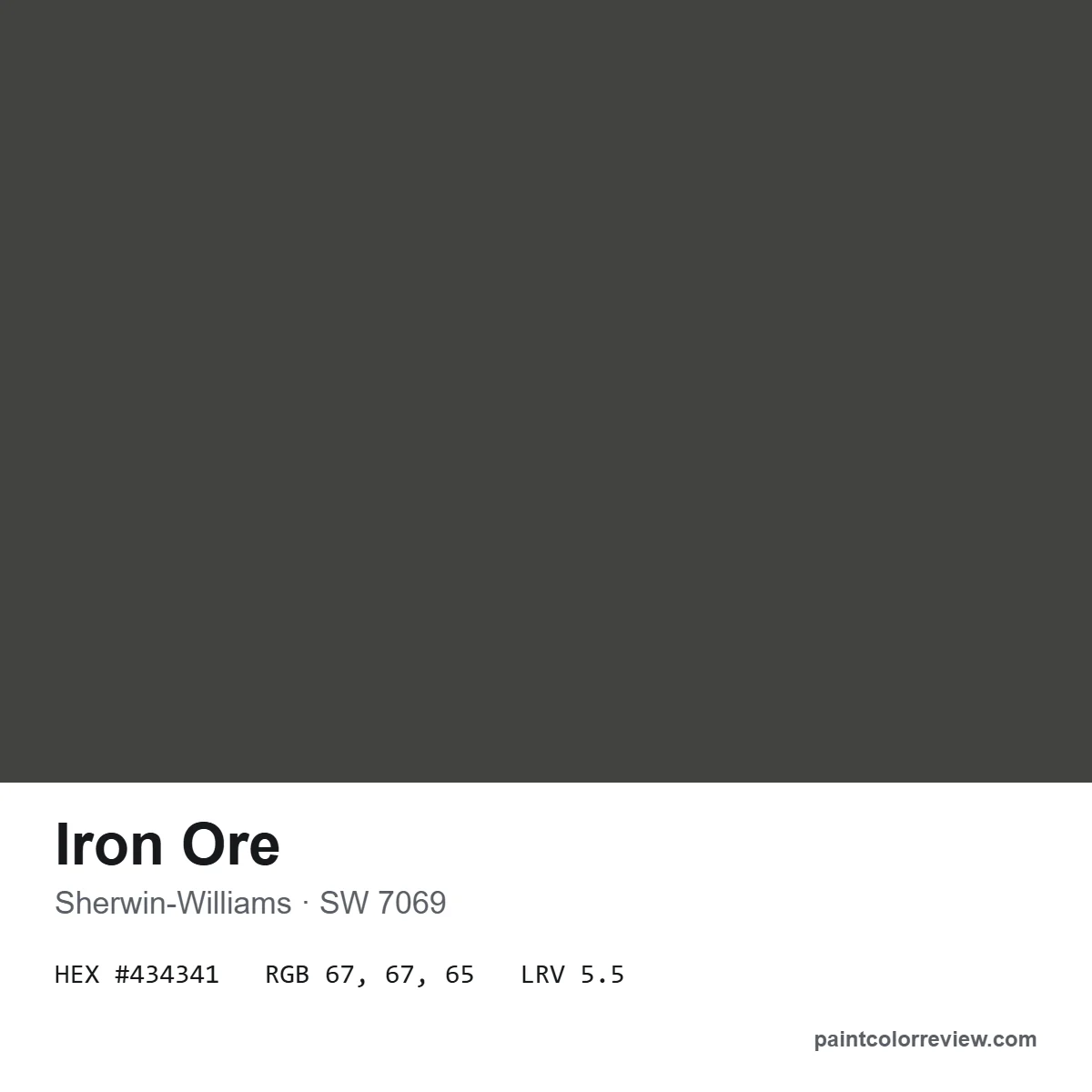
Sherwin-Williams lists Iron Ore (SW 7069) as hex #434341, RGB 67, 67, 65 and LRV 5.5.
Colors that go with Iron Ore
Sherwin-Williams pairs Iron Ore with Nebulous White, Extra White and the mid gray Cityscape. Warm woods, natural stone and brass add contrast to its cool neutrality.
Iron Ore vs other dark neutrals
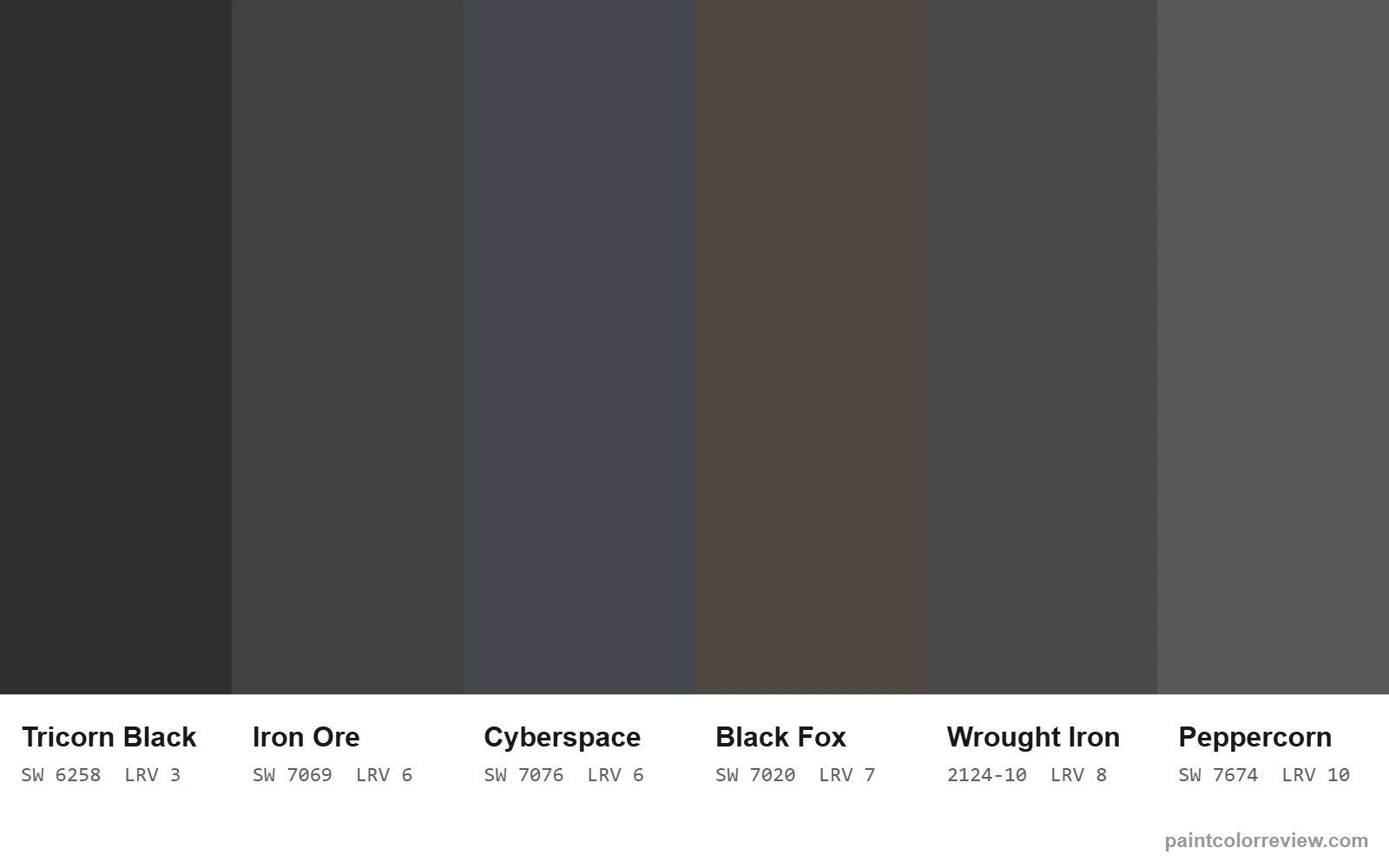
Iron Ore vs Urbane Bronze
Urbane Bronze is lighter (8.1) and clearly warmer and browner, 5.5 apart. Our Iron Ore vs Urbane Bronze comparison covers which suits each house style.
Iron Ore vs Peppercorn
Peppercorn is a lighter, perfectly neutral charcoal (LRV 9.7), 7.4 apart; see Iron Ore vs Peppercorn.
Iron Ore vs Tricorn Black
Tricorn Black (LRV 2.8) is the true black on the same strip, 6.8 apart. Use Tricorn Black for crisp, graphic contrast and Iron Ore when black would feel too harsh.
Iron Ore vs Black Fox
Black Fox (LRV 6.7) is a touch lighter and much warmer, 4.8 apart: espresso-charcoal against Iron Ore’s neutral charcoal.
Iron Ore vs Cyberspace
Cyberspace (SW 7076, LRV 6.4) is a near-black with a blue cast, 4.8 apart. Pick it if you want a dark color that leans navy.
Which soft black is right for your room?
Choose Iron Ore for modern, mixed or cool schemes; Black Fox or Urbane Bronze for wood-heavy, warm rooms; Tricorn Black for a true black on doors and windows; Cyberspace for a hint of blue.
How to test Iron Ore
On an exterior, look at a large sample in direct sun and in shade; the gap between the two is bigger for Iron Ore than for most colors. Indoors, place a sample next to Tricorn Black and Black Fox: seeing the true black and the warm option beside it makes Iron Ore’s neutral charcoal easy to judge. Always test in the sheen you plan to use, because satin looks lighter than flat.
Colors similar to Iron Ore
The closest Benjamin Moore color is Wrought Iron (2124-10), measured 3.1 apart: close in role, visibly different side by side. In Sherwin-Williams, Armory (SW 9600) is the nearest.
| Color | Brand | LRV | Difference (ΔE) | More |
|---|---|---|---|---|
| Armory SW 9600 | Sherwin-Williams | 4.8 | 3.3 | — |
| Greenblack SW 6994 | Sherwin-Williams | 4.1 | 3.7 | — |
| Rock Bottom SW 7062 | Sherwin-Williams | 7.0 | 3.7 | — |
| Wrought Iron 2124-10 | Benjamin Moore | 8.2 | 3.1 | — |
| Baby Seal Black 2119-30 | Benjamin Moore | 0.0 | 5.5 | — |
| Mysterious AF-565 | Benjamin Moore | 8.8 | 7.2 | — |
ΔE is the CIEDE2000 color difference between the two manufacturer colors: around 1 is barely visible; 2–3 is visible when the chips sit side by side.
Iron Ore FAQs
Is Sherwin-Williams Iron Ore black or gray?
It is a very dark charcoal gray that most people see as a soft black. Its LRV of 5.5 is about twice that of Tricorn Black (2.8), so sunlight reveals its gray.
What is the undertone of Sherwin-Williams Iron Ore?
Almost none. Measured, its green–red value is −0.4 and its yellow–blue value +1.2, a near-neutral charcoal with a hint of warmth. It looks slightly cool next to warm wood.
Is SW Iron Ore warm or cool?
Neutral, leaning very slightly warm by the numbers. Sherwin-Williams calls it cool because next to most warm finishes it reads as a cool charcoal.
Is Iron Ore the best black color for your room?
It is the best all-rounder: neutral enough for most schemes and softer than true black. Choose Black Fox or Urbane Bronze if your room is warm and wood-heavy, or Tricorn Black if you want a true black.
What colors go best with Iron Ore?
Sherwin-Williams pairs it with Nebulous White, Extra White and Cityscape. Alabaster and Pure White suit trim on warmer homes, and wood, stone and brass add contrast.
What is the LRV of Iron Ore?
Iron Ore has an LRV of 5.5, so it reflects about 5% of light and sits among the soft blacks.
What is the Benjamin Moore equivalent of Iron Ore?
Wrought Iron (2124-10) is the closest Benjamin Moore color in our data, 3.1 apart. It is a little lighter and slightly cooler.
Is Iron Ore good for exteriors?
Yes, it is one of the most used dark exterior colors. Sun softens it to charcoal. Check vinyl siding guidance before using very dark colors.